In the invisible world of microbiology, researchers and clinicians face a fundamental challenge: how do you study something you cannot see with the naked eye? The answer lies in culture media.
A culture medium is a specialized mixture used in laboratories to provide the precise nutrients required for microorganisms to grow, multiply, and reveal their identity. Whether testing for a bacterial infection in a hospital or ensuring the safety of our food supply, understanding the different types of media is the cornerstone of microbial science.
What is a Culture Medium?
A culture medium (plural: media) is a liquid or solidified formulation containing essential nutrients like carbon, nitrogen, vitamins, and minerals. Because microorganisms are incredibly diverse—ranging from hardy soil bacteria to “fastidious” pathogens that require specific growth factors—scientists have developed hundreds of different media types.
Classification of Bacterial Culture Media
To make sense of the vast array of available options, microbiologists classify media based on three primary criteria: consistency, composition, and functional purpose.
1. Classification Based on Consistency
The physical state of the medium determines how it can be used to observe bacterial behavior.
A. Solid Medium
Solid media contain a solidifying agent called agar at a concentration of 1.5% to 2.0%. Agar is ideal because most bacteria cannot digest it, and it remains solid at incubation temperatures ($37$°C).
Purpose: Useful for isolating pure cultures and observing colony morphology (shape, color, and edge).
Example: Nutrient Agar (NA).
B. Semi-Solid Medium
These are prepared with an agar concentration of 0.5% or less. They have a soft, custard-like consistency.
Purpose: Primarily used to determine bacterial motility (the ability of bacteria to move) or for growing microaerophilic bacteria that prefer lower oxygen levels.
Example: SIM Medium (Sulfide Indole Motility).
C. Liquid (Broth) Medium
Liquid media contain no agar.
Purpose: Used for the rapid propagation of large numbers of organisms, fermentation studies, and various biochemical tests.
Example: MR-VP Broth (Methyl Red and Voges-Proskauer).
2. Classification Based on Composition
This refers to whether we know exactly what is inside the “recipe.”
A. Synthetic or Chemically Defined Medium
In a synthetic medium, the exact chemical composition is known. It is prepared using precise amounts of pure chemical compounds like specific salts and sugars.
Example: Peptone Water ($0.5\%$ NaCl in water).
B. Non-Synthetic or Chemically Undefined (Complex) Medium
These contain at least one ingredient that is not chemically defined, such as yeast extract, beef extract, or peptone (digested proteins). Because these ingredients vary slightly from batch to batch, the exact molecular makeup is unknown.
Example: Nutrient Broth.
3. Classification Based on Purpose and Application
This is the most common way to categorize media in clinical and research settings.
I. General Purpose Media (Basic Media)
These are simple, “standard” media that support the growth of non-fastidious microorganisms (those that aren’t picky eaters). They are used for primary isolation.
Examples: Nutrient Broth, Nutrient Agar, Peptone Water.
II. Enriched Medium
Some bacteria are fastidious, meaning they require extra “luxury” nutrients like blood, serum, or egg yolk to grow.
Blood Agar: Prepared by adding 5-10% sheep or horse blood to a base.
Chocolate Agar: Heated blood agar (which turns brown/chocolate colored), used to grow organisms like Haemophilus influenzae.
III. Selective and Enrichment Media
These media are designed to “pick a winner.” They inhibit the growth of unwanted microbes (like normal flora) while encouraging the pathogen you are looking for.
Selective Medium (Solid): Uses inhibitory agents like antibiotics, dyes, or high salt concentrations to stop unwanted growth.
Mannitol Salt Agar (MSA): Contains 7.5%–10% NaCl, which inhibits most bacteria except Staphylococcus aureus.
MacConkey’s Agar: Contains bile salts and crystal violet to inhibit Gram-positive bacteria, selecting for Gram-negative enteric bacteria.
Enrichment Culture Medium (Liquid): Used to increase the concentration of a specific pathogen in a sample before plating it on solid media.
Example: Selenite F Broth, used to recover Salmonella from fecal samples.
IV. Differential or Indicator Medium
These media don’t necessarily stop bacteria from growing, but they make different types look different based on their metabolism. This is often achieved through pH indicators or dyes.
MacConkey’s Agar: Also acts as a differential medium; lactose fermenters turn pink, while non-fermenters remain colorless.
Mannitol Salt Agar: S. aureus ferments mannitol, changing the medium color from red/pink to yellow.
V. Transport Media
When a clinical specimen (like a swab or stool sample) is collected, it may take hours to reach the lab. Transport media prevent the specimen from drying out (desiccation) and prevent the “overgrowth” of contaminating bacteria while keeping the pathogen alive.
Example: Cary-Blair Medium, used for transporting feces from suspected cholera patients.
VI. Anaerobic Media
Anaerobic bacteria cannot survive in the presence of oxygen. These media require special nutrients (like Vitamin K and Hemin) and must be “reduced” to remove oxygen.
Robertson’s Cooked Meat (RCM) Medium: Contains pieces of ox heart. The unsaturated fatty acids in the meat consume oxygen through auto-oxidation, creating an oxygen-free environment at the bottom of the tube.
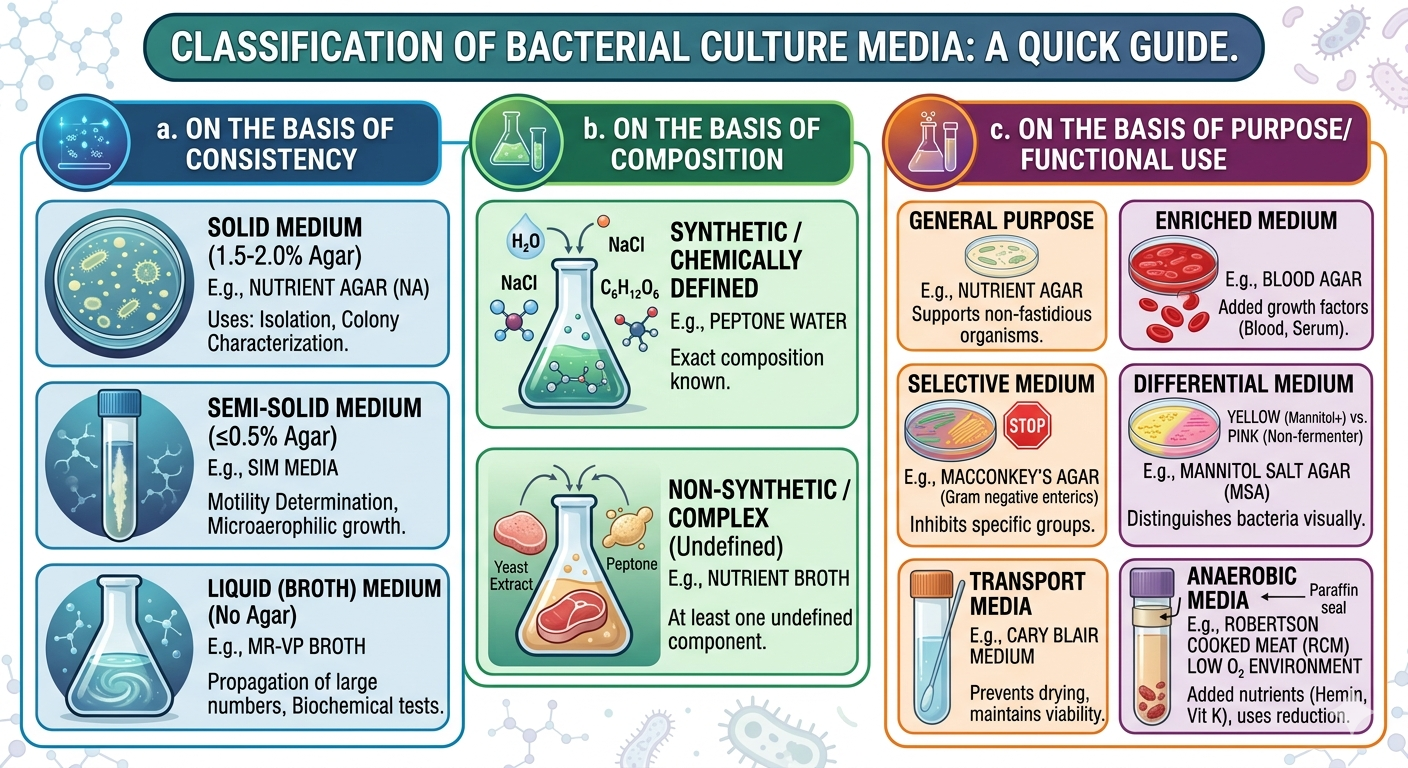
Comparison Table: Types of Media at a Glance
| Media Type | Consistency | Key Feature | Common Example |
| Solid | 1.5-2% Agar | Forms distinct colonies | Nutrient Agar |
| Semi-Solid | <0.5% Agar | Used for motility tests | SIM Medium |
| Liquid | No Agar | Rapid growth/Large volumes | Nutrient Broth |
| Enriched | Solid | Added blood or serum | Blood Agar |
| Selective | Solid/Liquid | Inhibits specific groups | MacConkey’s Agar |
| Differential | Solid | Distinguishes by color | Mannitol Salt Agar |
Why Choosing the Right Medium Matters
In clinical diagnostics, choosing the wrong medium can lead to a false negative, where a pathogen is present in the patient but fails to grow in the lab. For example, if a doctor suspects a Streptococcus infection but uses basic Nutrient Agar instead of Blood Agar, the bacteria might not grow, delaying life-saving treatment.
Similarly, in food safety, selective media allow scientists to find a single E. coli cell in a sea of harmless bacteria, preventing outbreaks of food poisoning.
Summary
The world of microbiology relies heavily on the diversity of culture media. By manipulating the consistency, chemical composition, and inhibitory agents, scientists can create a bespoke environment for any microorganism on Earth. From the simple Nutrient Broth to the complex anaerobic meat media, these tools remain the gold standard for identifying the microbial life that impacts human health and the environment.
