Overview
The serological pipette is an essential laboratory instrument used for transferring milliliter-scale volumes of liquid, ranging from fractions of a milliliter up to 50 mL. Due to their versatility, these pipettes are a staple in cell biology, molecular biology, microbiology, and chemistry laboratories worldwide. Serological pipettes can be either plastic, sterile, and disposable, or glass, sterilizable, and reusable, depending on experimental requirements.
The key to using these pipettes efficiently lies in pairing them with a pipette dispenser, commonly known as a pipet-aid, which creates a partial vacuum to aspirate and dispense liquids with precision. This combination allows researchers to achieve accurate, repeatable measurements, reducing variability and improving experimental reliability. Serological pipettes are invaluable for tasks such as mixing chemical solutions, transferring cell suspensions, layering reagents of different densities, and handling delicate biological samples.
This guide explores the components, operation, and best practices for using serological pipettes, as well as their laboratory applications, safety considerations, and variants.
Components and Mechanism of Serological Pipettes
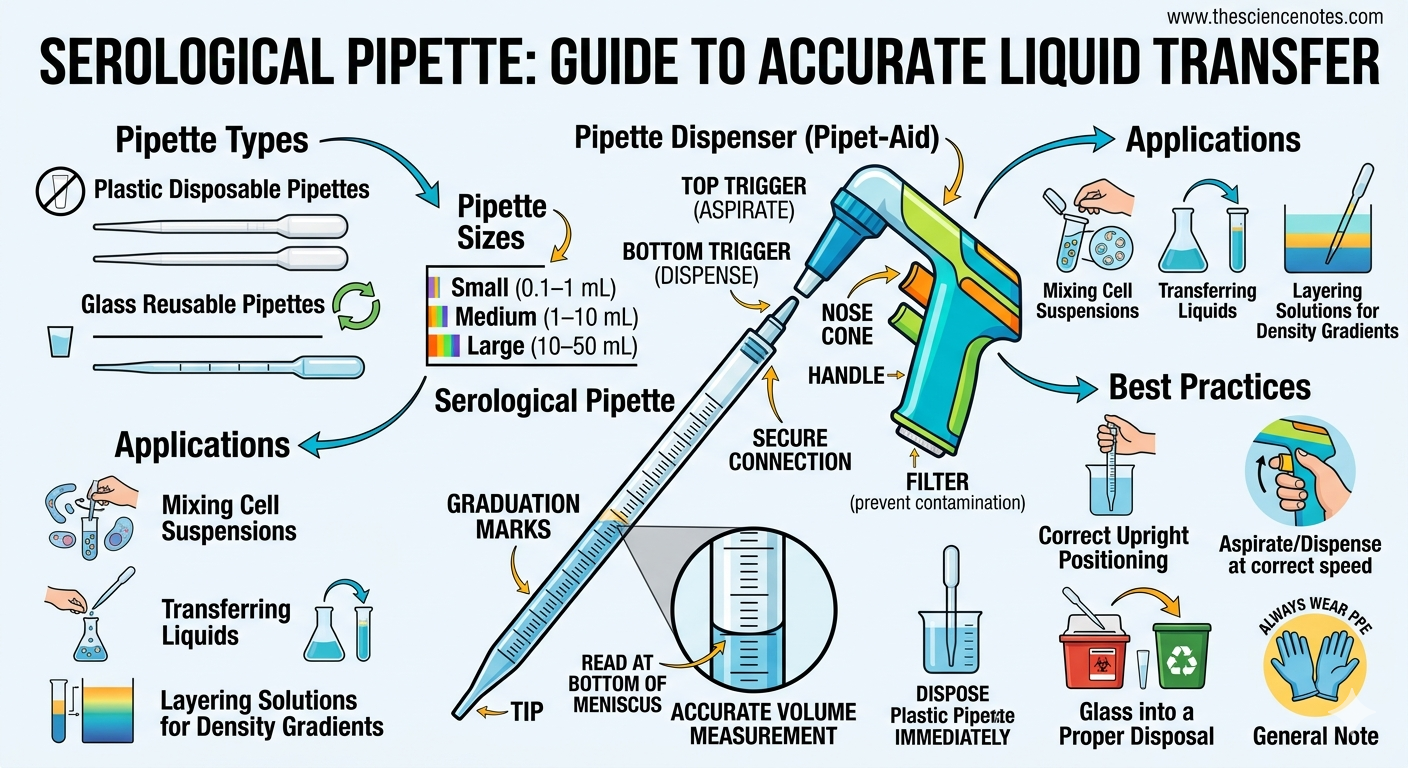
Serological pipettes consist of a long, narrow tube with graduation marks along the side to measure liquid volume. To operate, they rely on a pipette dispenser, which removes the need for outdated and unsafe mouth pipetting. Pipette dispensers create a controlled vacuum, allowing liquid to rise into the pipette.
Several types of pipette dispensers are commonly used:
Pipette Bulb – This simple device is usually applied with glass pipettes for non-critical liquid transfers. It provides the least precise control but is convenient for general mixing or non-quantitative experiments.
Pipette Pump – A more advanced option, the pipette pump allows precise control over liquid volume and is ideal for repeating identical measurements. This type is often used for experiments that require accurate repeated dispensing, such as serial dilutions or aliquot preparation.
Pipet-Aid – The most widely used dispenser in modern laboratories, the pipet-aid features:
A nose cone for secure pipette attachment and a sterility filter.
Dual triggers on the handle: the top for aspiration and the bottom for dispensing.
Adjustable dispense speed, including gravity mode (slow, gentle flow) and blow-out mode (faster, complete dispensing).
Battery operation or corded power supply for flexibility.
Optional stand attachments that allow the dispenser to rest horizontally while holding a pipette safely.
By understanding the components and function of your pipette and dispenser, you can ensure precise and reproducible transfers, which are critical for high-quality research outcomes.
Selecting the Right Pipette and Dispenser
The correct selection of a serological pipette is essential to achieving experimental accuracy. Pipette sizes vary widely and include:
1 mL for extremely small transfers
5 mL and 10 mL for medium volumes
25 mL and 50 mL for larger-scale liquid handling
Always select a pipette appropriate for the target volume, as using a pipette too large or too small can compromise accuracy and lead to experimental errors. After selecting the pipette, remove it carefully from its packaging, handling it only above the graduation marks to maintain sterility. Securely attach the pipette to the dispenser before removing the rest of the wrapper.
Aspirating Liquid: Step-by-Step
To aspirate liquid with a serological pipette:
Prepare the sample: Remove the cap of the liquid container while maintaining a clean working area.
Hold the pipette vertically: This orientation ensures proper liquid movement and accurate measurement.
Aspirate gently: Depress the top trigger slowly to draw liquid into the pipette, preventing bubbles or splashing.
Measure precisely: Read the bottom of the meniscus against the graduation marks to confirm the correct volume.
Avoid contamination: Ensure the pipette tip does not touch non-sterile surfaces to protect sample integrity.
For smaller-volume pipettes, gentle trigger pressure is crucial. For larger volumes, firmer pressure ensures efficient aspiration without sacrificing accuracy.
Dispensing Liquid Correctly
After aspirating the liquid, dispense it carefully to prevent errors or contamination:
Hold the pipette at a 10–45° angle against the inside wall of the receiving vessel.
Depress the plunger lightly to the first stop to release the majority of the liquid.
Press to the second stop (blow-out) to expel the final droplets completely.
Use the tip ejector to safely dispose of the pipette tip.
Smooth, consistent plunger operation ensures reproducibility in experiments, while proper storage and tip replacement prevent cross-contamination. Always store pipettes upright when not in use.
Applications of Serological Pipettes
Serological pipettes are versatile tools used across a variety of laboratory procedures:
Mixing Cell Suspensions – Achieve uniform cell distribution for plating or culturing experiments.
Transferring Cell Colonies – Move isolated or treated cells for expansion or further analysis.
Layering Reagents – Create density gradients, such as Ficoll or Percoll gradients, to separate cells from blood plasma or other media.
Handling Sensitive Biological Samples – Pipettes enable gentle liquid handling, protecting delicate cells or fragile reagents from mechanical damage.
Safety Guidelines and Best Practices
Never perform mouth pipetting; always use a proper pipette dispenser.
Handle pipettes above the gradation marks to maintain sterility.
Apply smooth plunger pressure for small volumes and controlled dispensing.
Replace tips between samples to avoid contamination.
Do not exceed the pipette’s volume range to prevent damage.
Store pipettes upright when not in use.
Following these precautions ensures long-term reliability and prevents costly experimental errors.
Specialized Variants of Serological Pipettes
Advanced pipette types expand their utility:
Repeater Pipettes: Allow multiple identical volume transfers after a single aspiration, ideal for repetitive experiments.
Multichannel Pipettes: Designed for transferring liquid to multiple wells simultaneously, often used for 96-well plate assays or other high-throughput experiments.
These variants enhance efficiency and consistency, making them invaluable in modern high-volume or automation-focused laboratories.
Conclusion
Serological pipettes are indispensable laboratory instruments that provide precise, reproducible handling of milliliter-scale liquid volumes. Paired with a pipette dispenser, they ensure safe, accurate, and efficient liquid transfers across a wide range of biological, chemical, and analytical applications. By understanding the instrument’s components, using proper techniques, and selecting the appropriate pipette size, researchers can achieve highly reliable experimental results.
Always remember precision, sterility, and consistent technique are key to mastering the use of serological pipettes in any laboratory.
FAQ Section
Q1: What is a serological pipette used for?
A: Serological pipettes are used to transfer milliliter-scale liquid volumes with precision, including mixing chemical solutions, transferring cell suspensions, and layering reagents for density gradients.
Q2: How do you read the volume on a serological pipette?
A: Read the volume at the bottom of the meniscus along the graduation marks to ensure accurate measurement.
Q3: Can a single pipette dispenser be used with multiple pipette sizes?
A: Yes, most pipette dispensers, including pipet-aids, work with different sizes of serological pipettes, from fractions of a milliliter up to tens of milliliters.
Q4: What is the safest way to aspirate liquid with a serological pipette?
A: Always use a pipette dispenser to create a vacuum and avoid mouth pipetting. Aspirate gently, keep the pipette vertical, and avoid touching the tip to non-sterile surfaces.
Q5: What are some common laboratory applications of serological pipettes?
A: They are used for mixing cell suspensions, transferring chemical solutions, layering reagents for density gradients, and transferring entire colonies of cells for expansion or analysis.
