The scientific method is a systematic approach used to solve problems, explain natural phenomena, anddevelop reliable scientific knowledge. Although the idea of structured investigation dates back to ancient times, the scientific method became formalized during the European Renaissance. Thinkers like Francis Bacon, Galileo, and Isaac Newton helped establish the framework that scientists still use today.
This lab manual-style guide will walk students through the five key steps of the scientific method, provide real-life and lab examples, and include quiz questions and a printable worksheet with answers. This resource is designed to support classroom learning and reinforce scientific thinking.
What Is the Scientific Method?
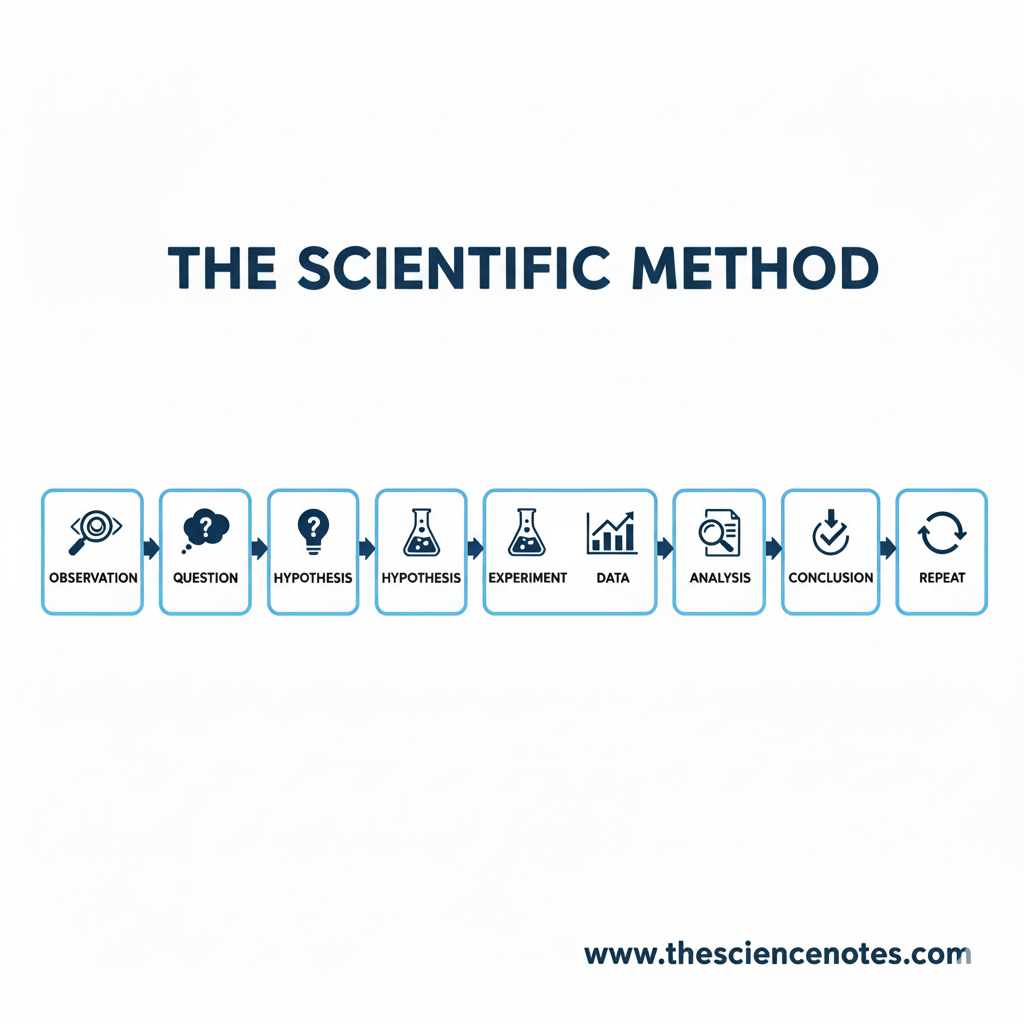
The scientific method is a step-by-step process that scientists use to investigate questions and test hypotheses. The goal is to make research repeatable, reliable, and objective. The scientific method is not just used in laboratories; it also applies to everyday problem-solving.
Step 1: Observation and Question
Every scientific investigation starts with an observation. Observations are followed by questions that guide the research.
Why observation is important
It identifies a problem or phenomenon.
It helps researchers define the scope of investigation.
It encourages background research and learning.
Example (Everyday Life)
You try to start your car, but it won’t start.
Observation:
“My car won’t start.”
Question:
“Why isn’t my car working?”
This simple process mirrors the scientific method: observation → question → investigation.
Background Research
Before testing, scientists review existing research to understand what is already known. This helps refine the question and avoids repeating past mistakes.
Step 2: Hypothesis (Alternative vs Null Hypothesis)
A hypothesis is an educated guess that offers a possible explanation for the observation.
What makes a good hypothesis?
✔ Testable – It can be supported or rejected through experimentation
✔ Falsifiable – It can be proven wrong if evidence contradicts it
Types of Hypotheses
| Hypothesis Type | Definition | Example |
|---|---|---|
| Alternative Hypothesis (H₁) | Predicts a relationship or effect | “Battery is dead because it’s cold.” |
| Null Hypothesis (H₀) | Predicts no change or effect | “Temperature has no effect on the battery.” |
Everyday Example (Car Troubleshooting)
Alternative Hypothesis: The battery is dead because it’s freezing outside.
Null Hypothesis: The cold has no effect on the battery.
Scientists test the hypothesis through experimentation to determine whether the null hypothesis can be rejected.
Step 3: Experimentation and Data Collection
After forming a hypothesis, scientists design experiments to test it.
Key Elements of Experimental Design
Independent Variable: The factor being changed
Dependent Variable: The outcome being measured
Control Group: Baseline for comparison
Replicates: Repeated trials to ensure accuracy
Qualitative Data: Descriptive observations
Quantitative Data: Numerical measurements
Everyday Example
Testing why a car won’t start:
Check if the gas tank is empty
Check the battery
Check the key
Try a jump start
These steps help identify the cause of the problem through controlled observation.
Control and Replicates
A control group is essential for comparing results. Without a control, the experiment becomes subjective.
Example: Testing soil salinity on plant growth
Control: Soil without salt
Experimental: Soil with added salt
Replicates ensure results are consistent and not due to random variation.
Step 4: Results and Data Analysis
Once data is collected, scientists analyze results to decide whether to reject the null hypothesis.
How to analyze results
Compare control vs experimental data
Use statistical tests to determine significance
If differences are significant, reject H₀
If not, fail to reject H₀
Important Note
Even if data supports the hypothesis, it is not considered proven. Future experiments may reveal new information.
Step 5: Conclusion and Future Research
The final step is drawing conclusions based on data and comparing results to existing research.
What should a conclusion include?
Explanation of results
Comparison to other studies
Discussion of limitations
Suggestions for future experiments
The scientific method is cyclical. If results do not support the hypothesis, scientists revisit earlier steps and refine the research question.
Lab Example: Soil Microbes and Plant Growth
Let’s apply the scientific method to a lab scenario.
Observation and Question
Microbes live in soil.
Question: Do soil microbes affect plant growth?
Hypotheses
Alternative Hypothesis: Adding a specific microbe will slow plant growth.
Null Hypothesis: Microbes have no effect.
Experimental Design
| Group | Soil Condition | Purpose |
|---|---|---|
| 1 | Sterile soil | Control |
| 2 | Sterile soil + microbe | Experimental |
| 3 | Natural soil | Control |
Variables
Independent Variable: Microbe presence
Dependent Variable: Plant growth
Controls: Groups 1 & 3
Replicates: Multiple plants per group
Conclusion
If group 2 grows slower than controls and results are statistically significant, the hypothesis is supported.
Quiz Questions
What is the first step in the scientific method?
Define a hypothesis.
What is the difference between a null hypothesis and an alternative hypothesis?
Why is a control group important?
What are replicates and why are they necessary?
What does it mean if you fail to reject the null hypothesis?
Printable Lab Worksheet
Fill in the blanks for the scientific method example: Soil Microbes and Plant Growth
| Step | Answer |
|---|---|
| Observation | |
| Question | |
| Alternative Hypothesis | |
| Null Hypothesis | |
| Independent Variable | |
| Dependent Variable | |
| Control Group | |
| Replicates | |
| Data Collected | |
| Conclusion |
✅ Worksheet Answers
| Step | Answer |
|---|---|
| Observation | Microbes are present in soil and may affect plant growth. |
| Question | Do soil microbes affect plant growth? |
| Alternative Hypothesis | Adding a specific microbe will slow plant growth. |
| Null Hypothesis | The presence or absence of microbes will have no effect on plant growth. |
| Independent Variable | Presence or absence of microbes |
| Dependent Variable | Plant growth (height or biomass) |
| Control Group | Group 1 (sterile soil) and Group 3 (natural soil) |
| Replicates | Multiple plants per group (3–5 recommended) |
| Data Collected | Plant height measurements over time |
| Conclusion | If group 2 grows slower than controls and results are statistically significant, the hypothesis is supported. |
✅ Answer Key (Scientific Method Quiz)
1. What is the first step in the scientific method?
Answer: The first step is observation, followed by asking a research question based on that observation.
2. Define a hypothesis.
Answer: A hypothesis is an educated guess or testable explanation for a phenomenon, based on prior knowledge.
3. What is the difference between a null hypothesis and an alternative hypothesis?
Answer:
Null Hypothesis (H₀): States that no change or effect will occur.
Alternative Hypothesis (H₁): States that a change or effect will occur.
4. Why is a control group important?
Answer: A control group provides a baseline for comparison so researchers can determine whether the experimental treatment caused the effect.
5. What are replicates and why are they necessary?
Answer: Replicates are repeated trials or samples of the same treatment. They are necessary to ensure results are reliable, accurate, and not due to random variation.
6. What does it mean if you fail to reject the null hypothesis?
Answer: It means there is not enough evidence to support the alternative hypothesis. The experiment did not show a significant effect.
