Introduction
The Winogradsky column is one of the most powerful and visually engaging tools used in microbiology and environmental science to study microbial diversity, metabolism, and ecological interactions. It is a miniature, self-contained ecosystem that allows microorganisms from natural sediments to grow, interact, and organize themselves into visible layers over time. Each layer represents a distinct microbial community adapted to specific chemical conditions.
Originally developed in the 1880s by Russian microbiologist Sergei Winogradsky, this technique transformed the way scientists understand microorganisms. Instead of studying microbes in isolation, the Winogradsky column highlights how microorganisms depend on one another and how they drive Earth’s biogeochemical cycles, including the carbon, sulfur, nitrogen, and iron cycles.
Today, the Winogradsky column is widely used in student laboratories, classrooms, and research settings because it demonstrates complex ecological principles using simple materials.
Why the Winogradsky Column Is Scientifically Important
The Problem of “Unculturable” Microorganisms
The vast majority of microorganisms on Earth are considered unculturable using standard laboratory techniques. This means they cannot grow on petri dishes or in test tubes under artificial conditions. There are several reasons for this:
Many microbes rely on metabolites produced by neighboring organisms
Some require very specific oxygen, light, or chemical gradients
Others grow slowly and are outcompeted in artificial media
The Winogradsky column overcomes these limitations by closely mimicking natural sediment environments. Instead of forcing microbes to grow alone, it allows them to develop within a complex, interacting community, making it possible to study organisms that would otherwise remain invisible.
Microbial Succession: Life Changes Over Time
What Is Microbial Succession?
Microbial succession refers to the sequential appearance and replacement of microbial communities as environmental conditions change. In a Winogradsky column, succession occurs because microorganisms continuously modify their surroundings as they grow.
For example:
Early microbes consume easily available nutrients
Their activity depletes oxygen or produces waste products
New microbes that can use these byproducts begin to thrive
This step-by-step transformation of the ecosystem mirrors what happens in ponds, wetlands, soils, and sediments across the planet.
Environmental Gradients in a Winogradsky Column
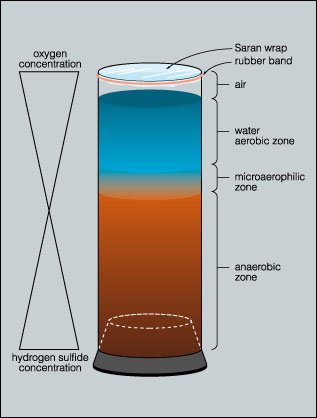
As the column matures, two major chemical gradients form:
Oxygen (O₂) Gradient
High oxygen levels at the top
Gradual decrease with depth
No oxygen in the bottom anaerobic zone
Hydrogen Sulfide (H₂S) Gradient
High sulfide concentration at the bottom
Decreases upward
Nearly absent near the surface
Microorganisms arrange themselves precisely along these gradients, growing where conditions are optimal for their metabolism.
How a Winogradsky Column Is Constructed
A Winogradsky column is built using mud and water from the same natural habitat, such as a pond, marsh, wetland, or stream. These sediments already contain a diverse microbial community.
Additional materials are added to support microbial growth:
Cellulose (shredded newspaper) as a carbon source
Sulfur (egg yolk or calcium sulfate) for sulfur metabolism
Light to support photosynthetic organisms
A transparent container to observe microbial layers
Once assembled, the column is incubated for 4–8 weeks, during which colorful microbial layers slowly appear.
Microbial Layers in a Winogradsky Column
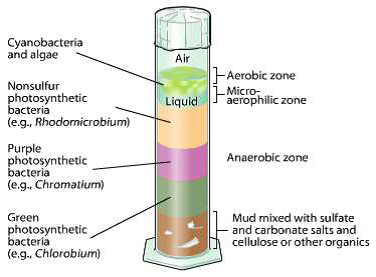
Each visible layer in the column represents a distinct functional group of microorganisms, organized from top to bottom based on oxygen and sulfide availability.
Table: Major Microbial Groups in a Classical Winogradsky Column
| Position in Column | Functional Group | Example Organisms | Visual Appearance |
|---|---|---|---|
| Top | Photosynthesizers | Cyanobacteria | Green or reddish-brown layer; oxygen bubbles |
| Upper layers | Nonphotosynthetic sulfur oxidizers | Beggiatoa, Thiobacillus | White filaments |
| Upper middle | Purple nonsulfur bacteria | Rhodospirillum, Rhodopseudomonas | Red, orange, or brown |
| Middle | Purple sulfur bacteria | Chromatium | Purple or purple-red |
| Lower middle | Green sulfur bacteria | Chlorobium | Green layer |
| Bottom | Sulfate-reducing bacteria | Desulfovibrio, Desulfobacter | Black sediment |
| Bottom | Methanogens | Methanococcus, Methanosarcina | Methane bubbles |
What Happens in Each Layer?
Top Layer: Cyanobacteria
Cyanobacteria perform oxygenic photosynthesis, producing oxygen as a byproduct. Oxygen bubbles often form in this layer, creating the aerobic zone of the column.
Middle Layers: Sulfur Bacteria
Purple and green sulfur bacteria use sulfide instead of water during photosynthesis
Purple nonsulfur bacteria use organic acids rather than sulfide
These organisms thrive where light, sulfide, and low oxygen overlap
Bottom Layer: Anaerobic Microorganisms
Sulfate-reducing bacteria break down organic acids and produce hydrogen sulfide
Methanogens produce methane gas from organic matter
Black sediment indicates iron sulfide formation
Step-by-Step Procedure for Building a Winogradsky Column
Materials Needed
Shovel, bucket, and sample bottle
Transparent 1-liter container
Mixing bowls and spoon
Egg yolk or calcium sulfate
Shredded newspaper
Plastic wrap and rubber band
Light source
Assembly Steps
Collect saturated mud and water from the same habitat
Remove rocks and debris
Mix mud with water until smooth
Add egg yolk and newspaper to one portion
Fill the column:
Bottom ¼: enriched mud
Middle ½: regular mud
Top: water
Seal and incubate in light at room temperature
Observe weekly for 4–8 weeks
Optional Experimental Modifications
Winogradsky columns are highly customizable and ideal for experimentation:
Salt addition → enriches halophiles
Iron (nail or steel wool) → selects iron-oxidizing bacteria
Temperature changes → select thermophiles or psychrophiles
Light intensity variation → affects photosynthetic growth
Colored cellophane → tests wavelength-dependent photosynthesis
Dark incubation → suppresses all photosynthetic organisms
Observing and Analyzing Results
After several weeks:
Light-incubated columns develop green, purple, and red layers
Dark-incubated columns lack photosynthetic layers
Black sediment still forms due to sulfate reducers
Environmental factors such as sediment porosity, sulfate availability, and microbial diversity strongly influence the final appearance of each column.
Educational Value of the Winogradsky Column
The Winogradsky column is widely used to teach:
Microbial ecology
Anaerobic vs aerobic metabolism
Biogeochemical cycles
Ecosystem interdependence
Environmental gradients
It is particularly effective because students can see microbial processes happening in real time, making abstract concepts tangible and memorable.
Summary and Key Takeaways
The Winogradsky column is a powerful demonstration of how microbial life organizes itself in response to chemical gradients and environmental change. By recreating a natural sediment ecosystem, it allows students to observe microbial succession, sulfur cycling, and ecological cooperation within a single transparent container.
This experiment highlights the importance of microorganisms in shaping Earth’s environments and emphasizes that life rarely exists in isolation. Instead, microbial communities function as interconnected systems that sustain global biogeochemical proccess.
