The micropipettor is a cornerstone instrument in modern biological and chemical laboratories, designed specifically for the precise transfer of very small liquid volumes ranging from 0.5 μl to 5000 μl. Used worldwide, this instrument is indispensable for experiments that require exact measurements, such as cell culture handling, DNA and protein analysis, and biochemical assays. Micropipettors rely on air displacement technology, where air is displaced from the pipette shaft to create a vacuum that draws liquid into a disposable tip. With a bit of practice, even first-time users can achieve high accuracy and consistency in microvolume liquid transfers.
Components and Functionality of Micropipettors
Micropipettors share a similar design across different models, featuring essential components that enable precise aspiration and dispensing of liquid samples:
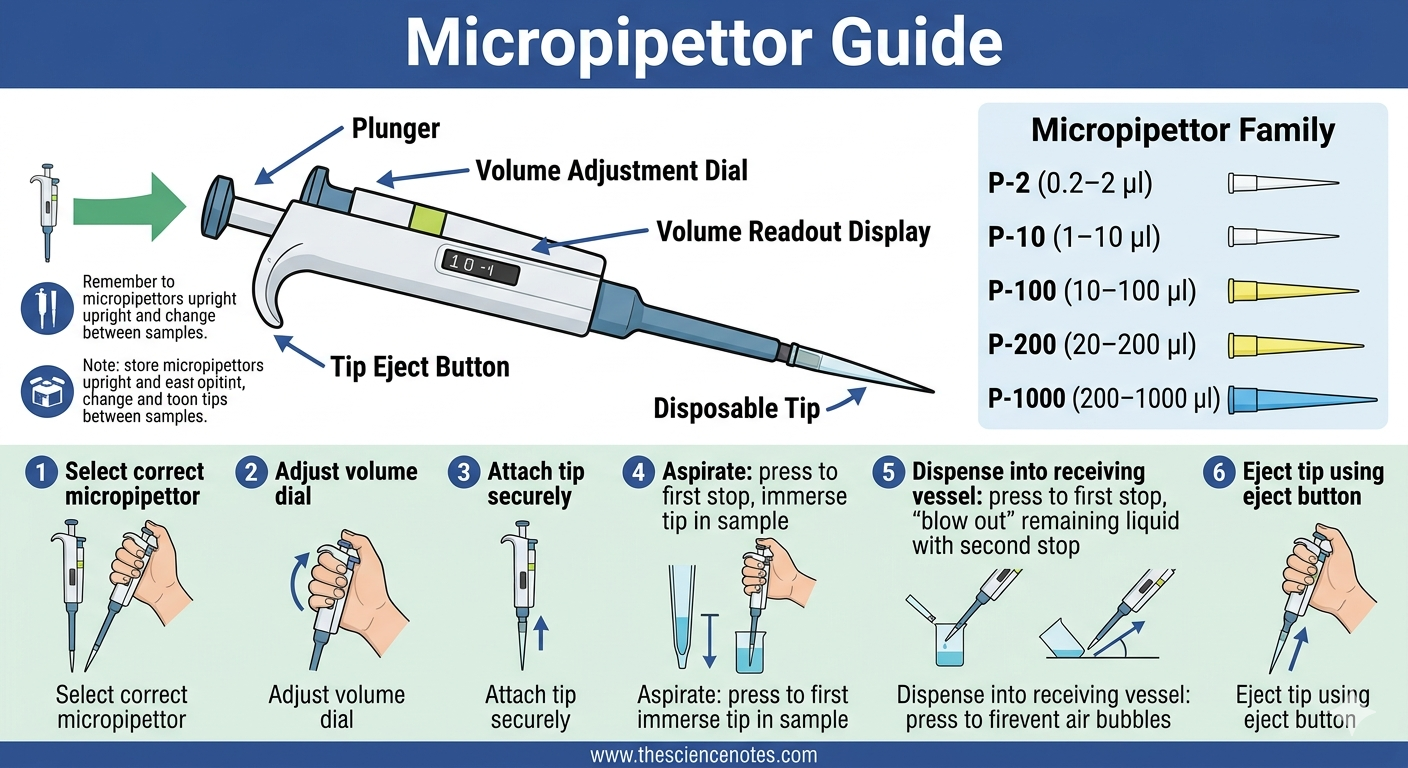
Plunger: Located at the top of the micropipettor, the plunger controls the uptake and release of liquid. Depressing the plunger to specific stops allows air displacement and liquid transfer.
Volume Adjustment Dial: This dial lets the user select the exact volume to be transferred, ensuring accurate measurements within the instrument’s range.
Volume Readout Display: Numbers on the display indicate the chosen volume in microliters, typically read from top to bottom. Different micropipettor models reflect volume digits differently, representing various orders of magnitude.
Disposable Tips: Pipette tips are attached to the lower end of the micropipettor and come in sizes corresponding to the micropipettor’s volume range.
Tip Eject Button and Shaft: These mechanisms allow safe and convenient removal of used tips to prevent cross-contamination.
Micropipettor Family: Range and Sizes
Micropipettors come in a “family” of different models to cover a wide range of volumes. For example:
P-2: Transfers 0.2–2 μl, ideal for extremely small sample volumes.
P-10: Transfers 0.5–10 μl for slightly larger microvolumes.
P-100: Handles 10–100 μl, commonly used in molecular biology assays.
P-200: Transfers 20–200 μl, often used in cell culture and reagent handling.
P-1000: Transfers 200–1000 μl, suitable for larger sample volumes.
P-5000: For volumes up to 5000 μl in specialized applications.
The color-coded tips simplify identification: white tips for 0.5–2.5 μl, yellow tips for 1–200 μl, and blue tips for 200–1000 μl. Correct tip selection is crucial for experimental accuracy.
Step-by-Step Micropipettor Operation
To achieve precise microvolume transfers, follow these steps:
Select the appropriate micropipettor based on the volume range needed. Using the correct instrument ensures accurate results.
Adjust the volume dial to your target volume. Turn counterclockwise to increase the volume and clockwise to decrease it. Pass the desired volume slightly and return slowly for optimal precision.
Attach the appropriate tip to the micropipettor, ensuring it fits securely.
Hold the micropipettor upright, with the narrow end in your palm and the overhang resting on your index finger.
Depress the plunger halfway to the first stop to displace air from the tip.
Immerse the tip 1–3 mm into the liquid sample, and slowly release the plunger. Wait for one second to allow the liquid to fill the tip fully.
Inspect the tip for air bubbles, which can compromise volume accuracy.
Dispense the liquid by holding the micropipettor at a 10–45° angle against the receiving vessel, pressing to the first stop, and then fully to the second stop for “blow-out.”
Eject the tip safely into the appropriate receptacle using the tip eject button.
Consistent plunger pressure, upright storage, and careful handling ensure the micropipettor remains accurate and functional over time. Always replace tips between transfers to prevent cross-contamination.
Common Laboratory Applications
Micropipettors are versatile instruments used for various laboratory applications:
Cell Culture: Transferring precise volumes of cell suspensions into culture plates for assays and experiments.
Analytical Techniques: Loading samples into DNA gels, microplate readers, or other molecular biology instruments.
Tissue Dissociation: Mechanically disrupting tissues to create single-cell suspensions for downstream applications.
High-Throughput Assays: Using multichannel pipettes to load entire rows of 96-well plates efficiently.
Serial Transfers: Repeater pipettes allow repeated aliquots from a single aspiration, ideal for repetitive experiments.
Micropipettors come in various formats, such as air displacement, positive displacement, multichannel, and repeater pipettes, each optimized for specific laboratory needs.
Tips for Accuracy and Maintenance
Never exceed the pipettor’s volume range; doing so can damage the internal mechanism.
Change tips between samples to avoid cross-contamination.
Maintain a smooth plunger motion to ensure consistent results.
Store micropipettors upright when not in use.
Regularly calibrate micropipettors to maintain reliability in experimental results.
Conclusion
The micropipettor is an essential laboratory tool that provides unmatched precision and control when handling microvolumes of liquid. By understanding its components, practicing proper technique, and choosing the correct model and tips, researchers can achieve accurate and reproducible results in a wide range of experiments. From molecular biology to cell culture, micropipettors are vital for scientific discovery and laboratory efficiency.
