The human nervous system is arguably the most complex communication network in existence. Every thought you process, every movement you execute, and every sensation you feel is the result of rapid-fire electrical signals known as nerve impulses. But how does a biological cell—made of water, lipids, and proteins—generate electricity?
To understand this, we must look at the work of Sir Alan Hodgkin and Sir Andrew Huxley. In the late 1930s, their pioneering research on the giant axon of the squid laid the foundation for modern neurobiology. They discovered that a nerve impulse, or action potential, is not a flow of electrons like in a copper wire, but a movement of ions across a semi-permeable membrane.
This article provides an in-depth, education-oriented exploration of how nerve impulses are generated, transmitted along an axon, and passed across the synaptic gap.
Defining the Nerve Impulse
A nerve impulse is a wave of electrochemical disturbance that passes along the neuron. It occurs due to mechanical, chemical, or electrical disturbances created by a stimulus. When this stimulus is strong enough to reach a specific threshold, the neuron generates an action potential.
The transmission of this impulse involves three distinct physiological phases:
Polarization (The Resting Potential)
Depolarization (The Action Potential)
Repolarization (The Recovery Phase)

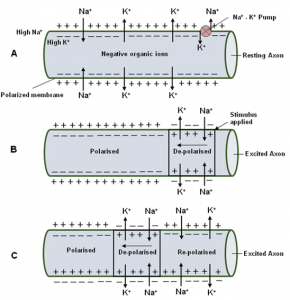
The stages of nerve impulse conduction and the restoration of resting potential via the sodium-potassium pump.
1. Polarization: The Resting Potential
Before a signal ever travels, the neuron must be “primed.” This stage is known as Polarization.
The Charge Difference
In its resting state, the inside of the neuron’s membrane maintains a negative electrical potential compared to the outside. This difference, known as the resting potential, typically ranges from -40mV to -90mV.
The Ion Gradient
The neuron maintains this potential through an unequal distribution of ions:
Outside (Interstitial Fluid): Contains a high concentration of sodium ions (Na+), roughly 16 times higher than the inside.
Inside (Axoplasm): Contains a high concentration of potassium ions (K+), about 25 times higher than the outside.
The Na-K Pump
Naturally, Na+ wants to diffuse in and K+ wants to diffuse out. However, the resting membrane is significantly more permeable to K+ than to Na+. To maintain the balance, the neuron uses a sodium-potassium pump. This carrier protein uses energy (ATP) to actively transport ions against their concentration gradients, keeping the neuron in its polarized state. At this stage, both specific sodium and potassium voltage channels remain closed.
This state of resting neuron is called Polarized state and it is electro-negatively charged.
Sodium Potassium Pump: Structure, Mechanism, Function, and Clinical Significance
2. Depolarization: The Action Potential
When a stimulus reaches a certain threshold, it triggers the initiation of a nerve impulse.
The Sodium Flood
Upon stimulation, the sodium channels open while the potassium channels remain closed. Driven by the concentration gradient, Na+ ions flood into the cell. This massive influx of positive charge flips the internal potential from negative to positive, reaching approximately +40mV.
The Wave of Electricity
This change is incredibly brief, lasting only about 3 milliseconds. This reversal of charge is called Depolarization. This localized change stimulates adjacent voltage-gated channels, causing the action potential to sweep down the length of the neuron like a wave.
3. Repolarization: Returning to Rest
To fire again, the neuron must reset its electrical charge.
Potassium Exit: The sodium channels close, and the potassium channels open. K+ ions diffuse out of the cell along their concentration gradient.
Hyperpolarization: Initially, so many K+ ions flow out that the inside becomes even more negative than its original resting state.
The Reset: The Na-K pump reactivates to re-establish normal concentrations. For every three Na+ ions the pump moves out, it brings two K+ ions back in. This restores the membrane to its original resting potential.
The membrane is once again at its resting potential.
Saltatory conduction:

In the human body, some signals need to travel faster than others. Medullated (myelinated) nerve fibers transmit impulses 20 times faster than non-medullated ones.
Because the myelin sheath is impermeable to ions, depolarization can only occur at the small gaps called Nodes of Ranvier. The action potential “jumps” from one node to the next. This efficient, jumping movement is known as Saltatory Conduction.
Mechanism of transmission of nerve impulse across the synapse.
Following are the steps for the process:
1.When an impulse arrives at the pre-synaptic knob of axon Ca++ ions concentrate at the synapse.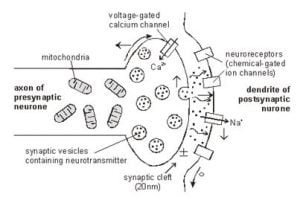
2.Ca++ions pass from the synaptic cleft into synaptic knob and cause the movement of synaptic vesicles towards to the surface of knob. Vesicles discharge their neurotransmitters chemicals acetylcholine in to the synaptic cleft and return to the cytoplasm of synaptic knob to refill neurotransmitters.
3.The neurotransmitter binds with protein receptor molecules in synaptic cleft. Na+ ions enter into the cell of another neuron and action potential generates on it. Thus nerve impulse transferred to the next synapse.
4.The acetylcholine is hydrolyzed by an enzyme acetyl cholinesterase into acetic acid and choline in the cleft which are reabsorbed into synaptic knob and resynthesized into acetylcholine using energy from ATP.
Stages of the Nerve Impulse
| Stage | Main Ion Movement | Membrane Potential | Channel Status |
| Polarization | Na-K Pump (3 Na out/2 K in) | -70mV (Resting) | All Voltage Channels Closed |
| Depolarization | Na+ floods inside | +40mV (Action) | Na+ Gates Open / K+ Gates Closed |
| Repolarization | K+ flows outside | Dropping to -70mV | Na+ Gates Closed / K+ Gates Open |
| Refractory | Ions returning to normal | Returning to -70mV | Na-K Pump Active |
Clinical and Biological Significance
Understanding nerve impulses is vital for several fields of medicine:
Anesthesia: Local anesthetics like Lidocaine work by blocking sodium channels, preventing the generation of action potentials (pain signals).
Neurotoxins: Many snake venoms and pesticides inhibit acetylcholinesterase, causing the synapse to stay “on” and leading to muscle paralysis or heart failure.
Multiple Sclerosis (MS): This disease involves the destruction of the myelin sheath, which disrupts saltatory conduction and slows down or stops nerve signals.
Conclusion
The transmission of a nerve impulse is a masterpiece of biological engineering. Through the precise manipulation of Sodium and Potassium ions, the body creates an electrical language that allows for the complexity of human life.
