Introduction: Understanding the Cell Cycle and CFSE T Cell Proliferation Assay
The cell cycle and CFSE T cell proliferation assay are central topics in modern biology, especially in cell biology, immunology, and biomedical research. Every living organism depends on controlled cell division to grow, repair tissues, and respond to environmental changes.
The cell cycle refers to the ordered sequence of events that a cell undergoes to duplicate its DNA and divide into two daughter cells. This process occurs throughout an organism’s life and is carefully regulated to maintain cellular health and genetic stability.
Cell division is essential for:
Embryonic development from a single fertilized egg (zygote)
Growth of tissues and organs
Replacement of damaged or dead cells
Immune system activation
Maintenance of organ function
Healing of wounds and injuries
In scientific research, understanding how cells divide is extremely important. One powerful experimental method used to measure immune cell division is the CFSE T cell proliferation assay, which uses fluorescent labeling combined with flow cytometry.
This technique allows scientists to:
Track how many times cells divide
Measure immune cell activation
Study disease progression
Evaluate responses to treatments
Overview of the Cell Cycle
The cell cycle is a highly controlled biological process consisting of several sequential phases. Each phase ensures that the cell is fully prepared before progressing to the next stage.
Cells may either remain inactive or actively divide depending on the physiological needs of the organism.
Phases of the Cell Cycle Explained
1. Gap 0 (G0) Phase – The Resting State
The G0 phase is considered a non-dividing stage of the cell cycle.
Important features of the G0 phase include:
Cells are metabolically active but not dividing
Cells perform specialized functions
Many differentiated cells remain in G0 permanently
Some cells can re-enter the cycle when stimulated
Examples of cells often in G0:
Neurons
Muscle cells
Certain immune cells before activation
This stage helps the body conserve energy and maintain cellular stability.
2. Gap 1 (G1) Phase – Cell Growth and Checkpoint Control
The G1 phase is the first stage of active cell cycle progression.
During G1, several critical processes occur:
The cell increases in size
Proteins required for DNA replication are synthesized
Cellular organelles multiply
The cell evaluates environmental conditions
DNA integrity is checked
Key checkpoint events include:
Availability of nutrients
Presence of growth factors
DNA damage detection
Cell size verification
If conditions are unfavorable, the cell may return to the G0 phase instead of continuing the cycle.
3. S Phase – DNA Synthesis
The S phase is when the most critical event of the cell cycle occurs: DNA replication.
Major events during the S phase include:
Duplication of chromosomes
Formation of sister chromatids
Replication of histone proteins
Increased DNA content inside the nucleus
Preparation for accurate cell division
At the end of this phase, each chromosome consists of two identical chromatids.
4. Gap 2 (G2) Phase – Final Preparations for Division
The G2 phase ensures that the cell is completely ready for mitosis.
Important processes include:
Verification of successful DNA replication
Repair of DNA damage
Synthesis of mitotic proteins
Organization of microtubules
Preparation of spindle apparatus
This checkpoint prevents damaged or incomplete DNA from being passed to daughter cells.
5. M Phase – Mitosis and Cytokinesis
The M phase represents the actual division of the cell.
This phase consists of two major processes:
Mitosis
Mitosis includes several stages:
Prophase
Metaphase
Anaphase
Telophase
During mitosis:
Chromosomes condense
Nuclear envelope breaks down
Chromosomes align at the center
Sister chromatids separate
Cytokinesis
Cytokinesis is the final step where:
Cytoplasm divides
Two daughter cells form
Each daughter cell receives identical genetic material
Importance of the Cell Cycle and CFSE T Cell Proliferation Assay
Understanding the cell cycle and CFSE T cell proliferation assay is extremely important in several scientific disciplines.
In Immunology
Cell cycle analysis helps researchers understand immune responses such as:
Activation of T cells during infection
Expansion of immune cell populations
Immune response to vaccines
Detection of immune disorders
T cells proliferate when they recognize pathogens or abnormal cells.
In Cancer Biology
Cancer is primarily caused by uncontrolled cell division.
Cell cycle analysis helps scientists:
Study tumor growth
Identify abnormal proliferation patterns
Evaluate cancer treatments
Develop targeted therapies
In Medical Research
Researchers use cell proliferation assays to:
Study autoimmune diseases
Investigate inflammatory responses
Evaluate drug effects
Develop new immunotherapies
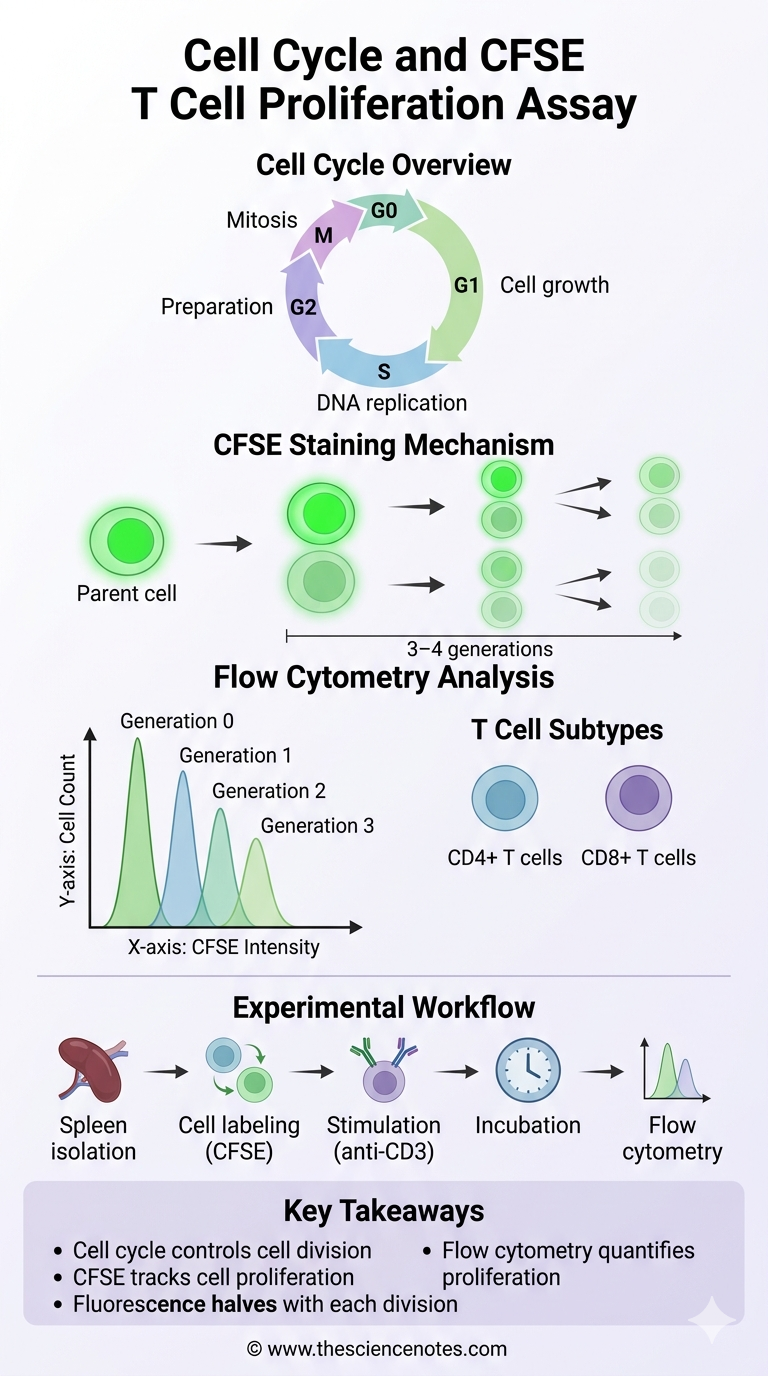
CFSE T Cell Proliferation Assay: Principle and Mechanism
The CFSE T cell proliferation assay is a widely used technique for tracking cell division in immunology experiments.
CFSE stands for:
Carboxyfluorescein Succinimidyl Ester
This fluorescent dye allows scientists to observe how cells divide over time.
How CFSE Works
The mechanism of CFSE staining involves several important steps:
CFSE enters live cells easily.
The dye binds permanently to intracellular proteins.
All cells initially display the same fluorescence intensity.
When a cell divides:
The dye is split evenly between daughter cells.
Each new generation has half the fluorescence of the previous one.
As a result:
First generation cells show highest fluorescence
Second generation shows reduced fluorescence
Later generations show progressively lower fluorescence
This pattern forms multiple peaks in flow cytometry analysis.
Role of Flow Cytometry in the CFSE T Cell Proliferation Assay
Flow cytometry is an essential analytical technique used in the cell cycle and CFSE T cell proliferation assay.
This technology allows rapid analysis of thousands of cells individually.
What Flow Cytometry Measures
Flow cytometry can measure:
Cell size
Cell complexity
Fluorescence intensity
Surface protein markers
Intracellular proteins
Important Flow Cytometry Parameters
Forward Scatter (FSC)
Indicates cell size.
Side Scatter (SSC)
Indicates internal complexity.
Fluorescence Channels
Used to detect:
CFSE signal
CD markers
Other fluorescent labels
Step-by-Step CFSE T Cell Proliferation Assay Protocol
1. Preparation Stage
Important preparation steps include:
Wearing laboratory gloves and protective clothing
Sterilizing dissection instruments
Preparing HBSS with fetal calf serum
Labeling experimental tubes
Proper preparation ensures experimental accuracy and prevents contamination.
2. Mouse Spleen Dissection
Steps involved:
Euthanize mouse using carbon dioxide system
Secure mouse on dissection board
Perform abdominal incision
Locate spleen attached to stomach
Carefully isolate spleen tissue
Transfer spleen into HBSS solution
The spleen is rich in immune cells, making it ideal for proliferation studies.
3. Immune Cell Isolation
The goal of this step is to obtain splenocytes.
Procedure includes:
Placing spleen on cell strainer
Crushing tissue to release cells
Collecting dissociated cells
Centrifuging to pellet cells
Lysing red blood cells
Washing immune cells
Adjusting final cell concentration
Cells are then ready for staining and stimulation.
4. CFSE Staining and T Cell Activation
Key steps:
Divide cells into experimental groups
Add CFSE dye
Incubate cells
Wash excess dye
Stimulate selected samples with anti-CD3 antibody
Culture cells in incubator
Two groups are analyzed:
Control group:
No stimulation
Baseline proliferation measurement
Stimulated group:
Activation of T cells
Increased cell division
Flow Cytometry Data Analysis for Students
Students often struggle with flow cytometry analysis, so here is a simplified breakdown.
Step 1: Identify Lymphocytes
Use FSC vs SSC plots.
Step 2: Gate T Cells
Select CD3 positive cells.
Step 3: Identify Subsets
Separate:
CD4 T cells
CD8 T cells
Step 4: Analyze CFSE Signal
Look at histogram peaks representing cell generations.
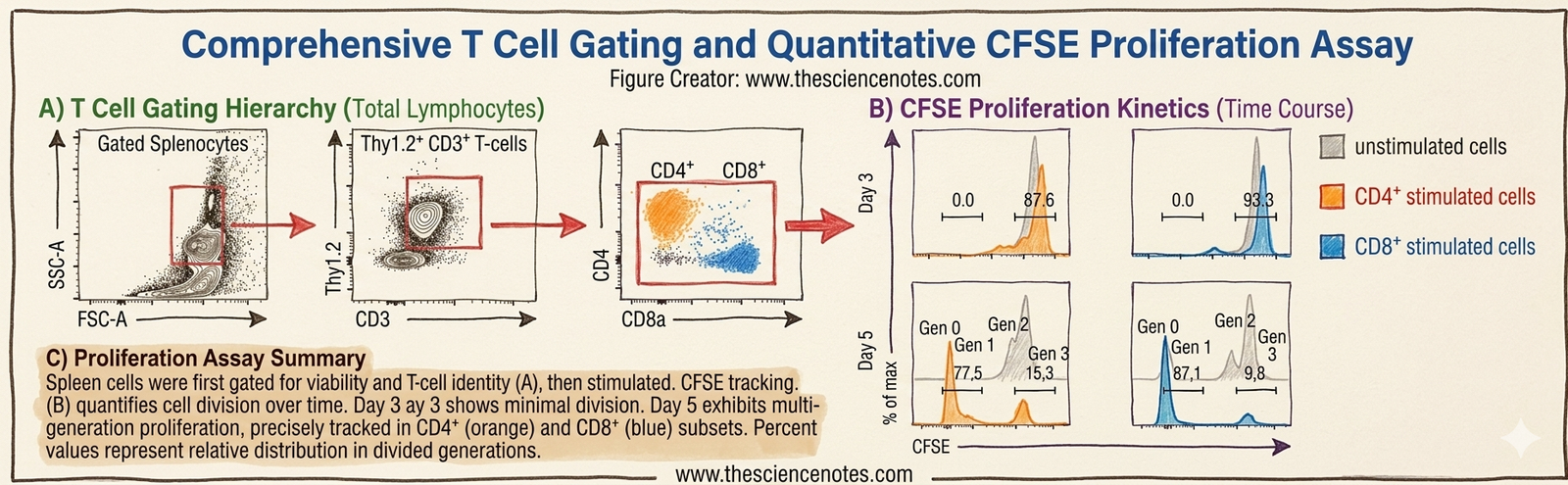
Results of the CFSE T Cell Proliferation Assay
Observations After 3 Days
Limited proliferation detected
CFSE peaks remain strong
Observations After 5 Days
Increased proliferation
Reduced fluorescence intensity
Clear generational peaks visible
Key Experimental Findings
CD4 T cells proliferate after stimulation
CD8 T cells show stronger proliferation
Stimulation significantly increases cell division
Applications of the Cell Cycle and CFSE T Cell Proliferation Assay
This assay is widely used in modern research.
Major applications include:
Immunology research
Cancer studies
Vaccine development
Drug testing
Autoimmune disease studies
Cell therapy research
Alternative Methods for Studying Cell Cycle
Other methods include:
BrdU Assay
Labels newly synthesized DNA.
EdU Assay
More sensitive and faster than BrdU.
Fucci Mouse Model
Allows real-time visualization of cell cycle phases.
Summary for Students
Understanding the cell cycle and CFSE T cell proliferation assay is essential for students studying life sciences.
Key learning points include:
Cell cycle phases regulate cell division
CFSE staining tracks cell proliferation
Flow cytometry provides quantitative analysis
Immune cells divide in response to stimulation
These techniques are widely used in biomedical research
