Artificial intelligence, often shortened to AI, is one of the most important scientific and technological fields of the modern world. It influences how we search for information, diagnose diseases, predict weather patterns, discover new drugs, analyze images from space, translate languages, detect fraud, design robots, and even write computer code. For students in science, engineering, mathematics, medicine, biology, chemistry, physics, environmental science, or any research-focused discipline, understanding artificial intelligence is no longer optional. It is becoming a core scientific skill.
At its simplest, artificial intelligence is the ability of machines to perform tasks that normally require human intelligence. These tasks may include recognizing patterns, learning from data, solving problems, understanding language, making predictions, and improving performance over time. AI does not mean that machines “think” exactly like humans. Instead, it means that computers can be designed to process information, identify relationships, and make decisions in ways that appear intelligent.
For undergraduate and graduate students, AI is especially important because it connects many areas of science. It uses mathematics, statistics, computer science, neuroscience, linguistics, cognitive science, engineering, and domain-specific knowledge. A biology student may use AI to analyze gene expression data. A physics student may use AI to classify particle collision events. A chemistry student may use AI to predict molecular properties. A medical student may use AI to interpret medical images. A climate science student may use AI to model environmental change.
This article explains what artificial intelligence is, how AI works, the main types of AI, the relationship between AI, machine learning, and deep learning, and why science students should learn it. The goal is to make AI understandable without oversimplifying the science behind it.
Table of Contents
- What Is Artificial Intelligence?
- Why Artificial Intelligence Matters for Students
- A Brief History of Artificial Intelligence
- How Artificial Intelligence Works
- Data: The Foundation of AI
- Algorithms: The Rules Behind AI
- Machine Learning: Teaching Computers from Data
- Deep Learning and Neural Networks
- Natural Language Processing and Generative AI
- AI in Science and Research
- Benefits of Artificial Intelligence
- Limitations and Risks of AI
- Skills Students Need to Learn AI
- Future of Artificial Intelligence
- Frequently Asked Questions
- Conclusion
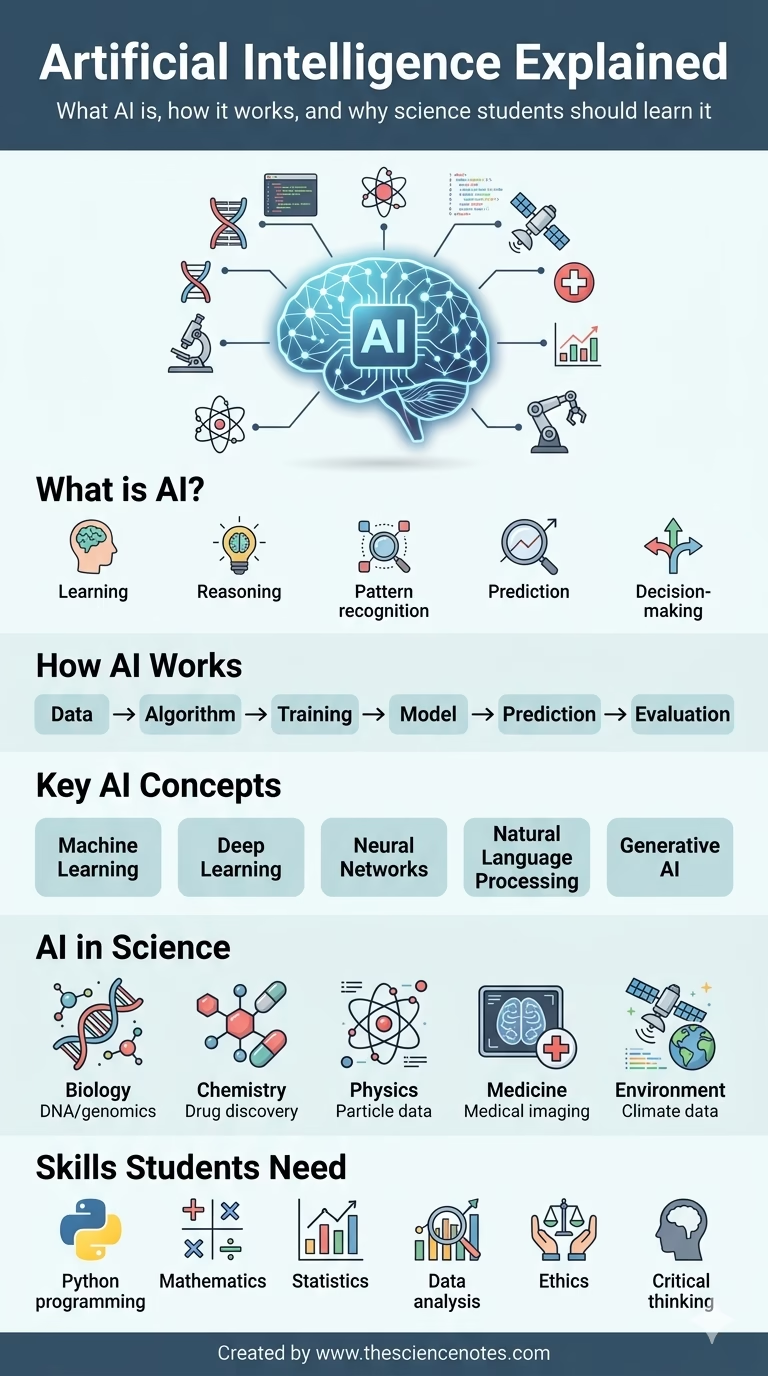
What Is Artificial Intelligence?
Artificial intelligence is a branch of computer science focused on building systems that can perform tasks associated with human intelligence. These tasks include learning, reasoning, perception, decision-making, planning, language understanding, and problem-solving.
A traditional computer program follows explicit instructions written by a programmer. For example, a simple calculator performs addition because a human wrote the exact rules for addition into the program. AI systems are different because many of them can learn patterns from data rather than depending only on fixed instructions.
For example, imagine you want to build a computer program that identifies whether an image contains a cat. In traditional programming, you would need to write rules describing what a cat looks like: pointed ears, whiskers, fur, eyes, body shape, tail, and so on. This is extremely difficult because cats can appear in many colors, sizes, poses, lighting conditions, and backgrounds.
In modern AI, especially machine learning, you can instead provide the computer with thousands or millions of labeled images. Some images contain cats, and some do not. The AI system studies the examples and learns patterns that help distinguish cat images from non-cat images. After training, the system can analyze a new image and estimate whether it contains a cat.
This ability to learn from data is one of the most powerful features of modern artificial intelligence.
AI is used in many everyday technologies, including:
- Search engines
- Recommendation systems
- Voice assistants
- Translation tools
- Facial recognition systems
- Medical imaging software
- Fraud detection systems
- Self-driving vehicle technologies
- Chatbots and virtual tutors
- Scientific data analysis tools
For students, the key point is this: AI is not magic. It is a combination of data, mathematical models, algorithms, computing power, and careful evaluation.
Why Artificial Intelligence Matters?
Artificial intelligence matters because it is changing both education and research. Whether students plan to become scientists, engineers, doctors, data analysts, professors, entrepreneurs, or policy experts, AI will likely affect their field.
For undergraduate students, AI provides a way to understand how modern technology works. It also builds important analytical skills, such as computational thinking, statistical reasoning, coding, and problem formulation.
For graduate students, AI can become a powerful research tool. Many graduate-level research projects now involve large datasets, complex simulations, automated analysis, or predictive modeling. AI can help researchers find patterns that are difficult to detect manually.
Science students should care about AI for several reasons.
First, AI helps analyze large and complex datasets. Modern science produces enormous amounts of data from telescopes, DNA sequencing machines, particle accelerators, satellites, sensors, microscopes, and clinical studies. Human researchers cannot manually inspect all of this data. AI can help organize, classify, and interpret it.
Second, AI improves prediction. Scientists often want to predict outcomes: Will a molecule bind to a protein? Will a patient develop a disease? Next, Will a storm intensify? Will a material conduct electricity efficiently? AI models can learn from historical data and generate predictions for new cases.
Third, AI supports automation. In laboratories, AI can help automate repetitive tasks, optimize experiments, and guide robots. This allows scientists to focus more on interpretation, theory, and discovery.
Fourth, AI is becoming part of scientific literacy. Just as students in science need to understand statistics, experimental design, and basic programming, they increasingly need to understand AI concepts. Even if they do not become AI specialists, they should know how to evaluate AI tools critically.
Finally, AI creates new career opportunities. Students with knowledge of both science and AI are valuable because they can apply computational methods to real scientific problems. A student who understands biology and machine learning, for example, may work in bioinformatics, drug discovery, genomics, or biomedical engineering.
A Brief History of Artificial Intelligence
The idea of artificial intelligence did not appear suddenly. Humans have imagined intelligent machines for centuries, but AI became a formal scientific field in the twentieth century.
Early work in logic, mathematics, and computing laid the foundation for AI. Researchers began asking whether machines could reason, solve problems, or imitate aspects of human thought. In the 1950s, artificial intelligence became a recognized area of study. Early AI programs focused on symbolic reasoning, game playing, theorem proving, and problem-solving.
One early approach to AI was called symbolic AI. In symbolic AI, researchers tried to represent knowledge using rules and symbols. For example, a medical expert system might use rules such as: “If a patient has fever, cough, and chest pain, consider a respiratory infection.” These systems were useful in some settings, but they struggled with uncertainty, ambiguity, and large-scale real-world data.
Later, researchers developed methods that allowed computers to learn from data. This led to the growth of machine learning, where systems improve their performance by analyzing examples. As computers became faster and datasets became larger, machine learning became more practical.
A major development was the rise of deep learning, a type of machine learning based on artificial neural networks with many layers. Deep learning has produced major advances in image recognition, speech recognition, natural language processing, robotics, and scientific modeling.
Today, AI includes many approaches, from rule-based systems to statistical learning, neural networks, reinforcement learning, evolutionary algorithms, probabilistic models, and generative AI. The field continues to evolve rapidly, but its central goal remains the same: building machines that can perform intelligent tasks.
How Artificial Intelligence Works
To understand how artificial intelligence works, it helps to break AI systems into several main components:
- Data
- Algorithms
- Models
- Training
- Evaluation
- Deployment
These components work together to create an AI system.
Suppose we want to build an AI model that predicts whether a student will pass a course based on attendance, assignment scores, quiz performance, study hours, and previous grades. The process might look like this:
First, we collect data from previous students. This data includes input features, such as attendance and grades, and an output label, such as pass or fail.
Second, we choose an algorithm. The algorithm is a mathematical procedure that learns patterns from the data.
Third, the algorithm produces a model. The model is the trained system that can make predictions.
Fourth, we train the model by allowing it to process many examples. During training, the model adjusts its internal parameters to reduce errors.
Fifth, we test the model on new data it has not seen before. This helps determine whether the model has learned useful patterns or simply memorized the training data.
Finally, if the model performs well, it can be deployed in a real application. However, it must still be monitored because real-world conditions may change.
This general process applies to many AI systems, whether they are used for image analysis, disease prediction, language translation, recommendation systems, or scientific modeling.
The important point is that AI systems usually do not “understand” in the human sense. Instead, they process information mathematically. They detect patterns, estimate probabilities, optimize objectives, and generate outputs based on learned relationships.
Data: The Foundation of AI
Data is the foundation of modern artificial intelligence. Without data, most AI systems cannot learn. Data provides examples from which models identify patterns.
In science, data may come from many sources:
- Laboratory experiments
- Sensors and instruments
- Surveys
- Medical records
- Satellite images
- Genomic sequencing
- Microscopy images
- Simulations
- Scientific literature
- Environmental measurements
For AI, data usually needs to be prepared before it can be used. This preparation is called data preprocessing. It may involve cleaning errors, removing duplicates, filling missing values, normalizing measurements, converting text into numerical form, labeling examples, or dividing data into training and testing sets.
High-quality data is essential. A model trained on poor data can produce poor results. This idea is often summarized as “garbage in, garbage out.” If the data is biased, incomplete, inaccurate, or unrepresentative, the AI system may also be biased or unreliable.
For example, if a medical AI system is trained mostly on data from one population, it may perform poorly on patients from other populations. If a climate model uses incomplete sensor data, its predictions may be less accurate. If a chatbot is trained on unreliable text, it may generate misleading information.
Science students should understand that AI is not only about algorithms. The quality of the data often matters as much as the sophistication of the model.
Algorithms: The Rules Behind AI
An algorithm is a step-by-step procedure for solving a problem. In AI, algorithms are used to process data, learn patterns, make predictions, classify information, or optimize decisions.
Some common AI and machine learning algorithms include:
- Linear regression
- Logistic regression
- Decision trees
- Random forests
- Support vector machines
- k-nearest neighbors
- Naive Bayes classifiers
- Neural networks
- Gradient boosting methods
- Reinforcement learning algorithms
Different algorithms are useful for different tasks. A linear regression model may be useful for predicting a continuous value, such as temperature or reaction yield. A classification model may be useful for identifying whether a tumor is benign or malignant. A clustering algorithm may be useful for grouping similar cells, genes, or chemical compounds.
Algorithms are not automatically intelligent. Their usefulness depends on how well they match the problem, the quality of the data, and the way they are evaluated.
A major idea in AI is optimization. Many AI systems work by minimizing error. During training, a model makes predictions, compares those predictions with the correct answers, calculates an error, and then adjusts itself to reduce future errors. This repeated adjustment is what allows many AI systems to learn.
For science students, algorithms should be understood as mathematical tools. They are not mysterious black boxes by nature, although complex models can become difficult to interpret. The more students learn mathematics, statistics, and programming, the easier it becomes to understand what AI systems are doing.
Machine Learning: Teaching Computers from Data
Machine learning is a major subfield of artificial intelligence. It focuses on systems that learn patterns from data and improve performance without being explicitly programmed for every possible situation.
Machine learning can be divided into several main types:
Supervised Learning
In supervised learning, the model is trained on labeled data. Each example includes input data and the correct output.
For example:
- Input: X-ray image
- Output: pneumonia or no pneumonia
- Input: molecule structure
- Output: predicted toxicity
- Input: student performance data
- Output: likely pass or fail
Supervised learning is widely used for classification and prediction tasks.
Unsupervised Learning
In unsupervised learning, the model receives data without labeled answers. The goal is to discover hidden patterns or structures.
For example, an unsupervised learning algorithm might group similar genes based on expression patterns, cluster galaxies based on shape, or identify unusual patterns in environmental sensor data.
Common unsupervised learning tasks include clustering, dimensionality reduction, and anomaly detection.
Reinforcement Learning
In reinforcement learning, an agent learns by interacting with an environment. It receives rewards or penalties based on its actions and tries to learn a strategy that maximizes reward.
Reinforcement learning is used in robotics, game-playing systems, control systems, and some optimization problems. For example, a robot may learn how to walk by trying different movements and receiving feedback based on balance and progress.
Semi-Supervised and Self-Supervised Learning
In many real-world situations, labeled data is limited, but unlabeled data is abundant. Semi-supervised learning uses a small amount of labeled data along with a larger amount of unlabeled data.
Self-supervised learning allows models to create learning tasks from the data itself. This approach has become important in language models, image models, and scientific AI systems because it can use very large datasets without requiring every example to be manually labeled.
Machine learning is important because it allows AI systems to handle complex problems where writing exact rules is difficult or impossible.
Deep Learning and Neural Networks
Deep learning is a type of machine learning that uses artificial neural networks with many layers. These networks are inspired loosely by the structure of biological nervous systems, although they are much simpler than real brains.
An artificial neural network consists of connected units called neurons or nodes. These nodes are organized into layers:
- An input layer receives data.
- Hidden layers process information.
- An output layer produces the final result.
Each connection between nodes has a numerical value called a weight. During training, the network adjusts these weights to improve its predictions.
For example, in an image recognition system, the early layers of a neural network may detect simple features such as edges and colors. Middle layers may detect shapes or textures. Deeper layers may detect more complex objects such as eyes, wheels, cells, or tumors.
Deep learning is powerful because it can automatically learn features from raw data. Traditional machine learning often requires humans to design useful features. For example, a scientist might manually define features of a molecule, such as molecular weight, charge, or bond structure. A deep learning model may learn useful representations directly from molecular graphs or sequences.
Deep learning has been especially successful in:
- Image recognition
- Speech recognition
- Natural language processing
- Medical imaging
- Protein structure prediction
- Autonomous systems
- Scientific simulation acceleration
- Generative AI
However, deep learning also has limitations. It often requires large datasets, significant computing power, and careful tuning. Deep neural networks can also be difficult to interpret, meaning it may be hard to explain exactly why they made a specific decision.
For students, deep learning is an important topic, but it should be learned after building a foundation in programming, linear algebra, calculus, probability, and statistics.
Natural Language Processing and Generative AI
One of the most visible areas of artificial intelligence today is natural language processing, or NLP. NLP is the field of AI that focuses on helping computers process human language.
NLP systems can perform tasks such as:
- Text classification
- Translation
- Summarization
- Question answering
- Speech recognition
- Sentiment analysis
- Information extraction
- Chatbot conversation
- Scientific literature analysis
A related area is generative AI, which refers to AI systems that can generate new content. This content may include text, images, code, music, video, molecular structures, or synthetic data.
Large language models are a major example of generative AI. These systems are trained on large amounts of text and learn statistical relationships between words, phrases, concepts, and contexts. They can generate essays, answer questions, explain concepts, write code, summarize documents, and assist with research workflows.
For students, generative AI can be useful as a learning assistant. It can help explain difficult topics, suggest study questions, draft outlines, debug code, and summarize complex material. However, students must use it responsibly. AI-generated content can contain errors, outdated information, unsupported claims, or fabricated references. It should not replace critical thinking, primary sources, instructor guidance, or original academic work.
A good rule for students is: use AI as a tutor, not as a substitute for learning.
AI in Science and Research
Artificial intelligence is transforming scientific research across many disciplines. It is especially useful when researchers deal with large datasets, complex systems, or prediction problems.
AI in Biology
In biology, AI is used to analyze genomic data, classify cell types, model protein structures, predict gene function, and study biological networks. Machine learning can help identify patterns in DNA sequences, RNA expression, and cellular images.
For example, AI can help researchers understand which genes are active in different diseases or predict how proteins may fold into three-dimensional structures. These applications can support drug discovery, personalized medicine, and molecular biology research.
AI in Chemistry
In chemistry, AI can help predict molecular properties, design new compounds, optimize reactions, and screen potential drugs. Instead of testing every molecule experimentally, researchers can use AI models to prioritize the most promising candidates.
AI can also help predict solubility, toxicity, stability, and binding affinity. This makes it useful in pharmaceutical chemistry, materials science, and chemical engineering.
AI in Physics
In physics, AI is used for data analysis, simulation, pattern recognition, and model discovery. Particle physicists use machine learning to analyze collision data. Astrophysicists use AI to classify galaxies, detect exoplanets, and process telescope images. Condensed matter physicists use AI to study materials and quantum systems.
AI does not replace physical theory, but it can help researchers explore complex datasets and generate hypotheses.
AI in Environmental Science
Environmental scientists use AI to study climate patterns, predict natural disasters, monitor deforestation, analyze satellite imagery, and model ecosystems. AI can process large volumes of geospatial data and identify trends that are difficult to detect manually.
For example, AI systems can analyze satellite images to track changes in forests, glaciers, oceans, and urban areas. This information can support conservation, climate policy, and disaster response.
AI in Medicine and Healthcare
In medicine, AI is used for medical image analysis, disease risk prediction, clinical decision support, drug discovery, hospital workflow optimization, and personalized treatment planning.
Medical AI must be handled carefully because errors can affect patient health. Models need rigorous testing, clinical validation, ethical review, and human oversight.
For science students interested in medicine, biomedical engineering, or public health, AI offers major opportunities but also requires strong ethical awareness.
Benefits of Artificial Intelligence
Artificial intelligence offers many benefits for students, scientists, and society.
Faster Data Analysis
AI can process large datasets much faster than humans. This is valuable in fields such as genomics, astronomy, neuroscience, and environmental monitoring.
Improved Prediction
AI models can identify patterns in historical data and use them to predict future outcomes. This is useful in weather forecasting, disease risk modeling, financial analysis, and engineering design.
Automation of Repetitive Tasks
AI can automate routine tasks, allowing humans to focus on complex reasoning, creativity, and decision-making. In laboratories, AI can assist with image labeling, data cleaning, experiment scheduling, and robotic control.
Personalized Learning
AI-powered education tools can adapt to individual student needs. They can provide practice questions, explanations, feedback, and study recommendations.
Scientific Discovery
AI can help discover new molecules, materials, patterns, and hypotheses. It can search large possibility spaces more efficiently than manual methods.
Accessibility
AI can support accessibility through speech-to-text tools, text-to-speech systems, image descriptions, translation, and assistive technologies.
Despite these benefits, AI should not be treated as a perfect solution. It is a tool, and like all tools, it must be used correctly.
Limitations and Risks of AI
Artificial intelligence has limitations that students must understand. A scientifically educated person should not only know what AI can do but also what it cannot do reliably.
AI Can Make Mistakes
AI systems can produce incorrect predictions or misleading outputs. Even advanced models can fail when they encounter unfamiliar data, ambiguous inputs, or poorly defined tasks.
AI Depends on Data Quality
If the training data is biased, incomplete, or inaccurate, the AI model may produce biased or inaccurate results. This is especially important in medicine, law, hiring, education, and public policy.
AI May Lack Interpretability
Some AI models, especially deep neural networks, are difficult to interpret. This can be a problem in scientific and medical settings where researchers need to understand why a model made a decision.
AI Can Overfit
Overfitting occurs when a model performs well on training data but poorly on new data. This means the model has memorized examples rather than learned general patterns.
AI Can Be Misused
AI can be used for harmful purposes, including misinformation, surveillance, cyberattacks, academic cheating, and manipulation. Ethical use is essential.
AI Does Not Replace Human Judgment
AI can support decision-making, but it should not replace expert judgment in high-stakes fields. Scientists, doctors, engineers, and policymakers must remain responsible for interpreting AI outputs.
For students, the most important lesson is that AI should be approached with both curiosity and skepticism. It is powerful, but it is not infallible.
Skills Students Need to Learn AI
Students from science backgrounds can learn artificial intelligence step by step. They do not need to master everything at once. A strong foundation is more important than rushing into advanced tools.
Mathematics
Important mathematical topics include:
- Linear algebra
- Calculus
- Probability
- Statistics
- Optimization
- Discrete mathematics
Linear algebra is especially important because AI models often represent data as vectors, matrices, and tensors. Calculus helps explain how models are trained using gradients. Probability and statistics help students understand uncertainty, inference, and model evaluation.
Programming
Python is the most common programming language for AI and data science. Students should learn:
- Basic Python syntax
- Data structures
- Functions
- File handling
- Libraries such as NumPy, pandas, matplotlib, scikit-learn, and PyTorch or TensorFlow
Students do not need to become expert software engineers immediately, but they should become comfortable writing, testing, and debugging code.
Statistics and Data Analysis
Students should understand concepts such as:
- Mean, median, variance, and standard deviation
- Correlation and causation
- Hypothesis testing
- Regression
- Confidence intervals
- Sampling bias
- Training and testing data
- Model accuracy and error
AI without statistics can lead to serious misunderstandings.
Domain Knowledge
Science students have an advantage because they understand the subject matter behind the data. An AI model for chemistry requires chemical knowledge.,for medicine requires biomedical understanding. An AI model for climate science requires environmental and physical knowledge.
The best AI applications often come from combining computational skills with domain expertise.
Critical Thinking and Ethics
Students must learn to ask:
- Where did the data come from?
- Is the data representative?
- What assumptions does the model make?
- How accurate is the model?
- What are the consequences of errors?
- Could the system be biased?
- Who is responsible for decisions based on AI?
These questions are essential for responsible AI use.
How Students Can Start Learning Artificial Intelligence
Students who want to learn AI should begin with a structured path.
First, learn basic programming. Python is a practical starting point because it is widely used in AI, data science, and scientific computing.
Second, study mathematics and statistics. Students should not ignore these foundations. AI tools may be easy to use, but understanding them requires mathematical thinking.
Third, learn basic data analysis. Before building advanced models, students should know how to clean data, visualize data, and calculate summary statistics.
Fourth, study machine learning fundamentals. Start with simple models such as linear regression, logistic regression, decision trees, and clustering. These models are easier to interpret than deep neural networks and teach important concepts.
Fifth, move into deep learning. Learn about neural networks, activation functions, loss functions, backpropagation, and model evaluation.
Sixth, work on projects. Projects help students move from theory to practice. Good beginner projects include predicting student performance, classifying plant species, analyzing climate data, identifying handwritten digits, or predicting molecular properties from chemical datasets.
Seventh, read research papers carefully. Graduate students especially should learn how AI methods are presented in scientific literature. Pay attention to datasets, evaluation methods, baselines, limitations, and reproducibility.
Finally, practice responsible AI use. Students should be transparent about when and how they use AI tools, especially in academic writing, research, and coding assignments.
Important AI Terms Students Should Know
Artificial Intelligence
The broad field of creating machines that perform tasks associated with human intelligence.
Machine Learning
A subfield of AI where systems learn patterns from data.
Deep Learning
A subfield of machine learning that uses neural networks with many layers.
Neural Network
A computational model made of connected nodes that process information.
Training Data
Data used to teach an AI model.
Model
A trained mathematical system that makes predictions or decisions.
Features
Input variables used by a model, such as temperature, age, gene expression level, or molecular weight.
Label
The correct output used in supervised learning, such as “disease” or “no disease.”
Overfitting
A problem where a model memorizes training data and performs poorly on new data.
Bias
Systematic error in data, modeling, or decision-making that can lead to unfair or inaccurate outcomes.
Generalization
The ability of a model to perform well on new, unseen data.
Generative AI
AI that creates new content, such as text, images, code, or molecular designs.
Artificial Intelligence vs. Human Intelligence
Artificial intelligence and human intelligence are not the same. Humans understand the world through consciousness, emotions, sensory experience, social interaction, memory, reasoning, and biological processes. AI systems operate through computation, data, statistical patterns, and optimization.
AI can outperform humans in specific tasks, such as analyzing huge datasets, calculating probabilities, recognizing patterns in images, or playing certain games. However, AI usually lacks common sense, emotional understanding, moral responsibility, and genuine awareness.
A student should avoid two extreme views. The first extreme is thinking AI is “just a calculator” and therefore not important. The second extreme is thinking AI is equivalent to human intelligence. The more accurate view is that AI is a powerful computational technology that can perform certain intelligent tasks extremely well but still has significant limitations.
The Future of Artificial Intelligence
The future of artificial intelligence will likely involve closer collaboration between humans and machines. AI systems may become more capable, more specialized, and more integrated into scientific research, education, healthcare, engineering, and daily life.
In science, AI may help design new materials, discover drugs, model complex systems, automate laboratories, and accelerate research. Field of education, AI may support personalized tutoring, automated feedback, and interactive simulations. In healthcare, AI may assist with diagnosis, treatment planning, and medical research.
However, the future of AI will also require careful governance. Questions about privacy, bias, accountability, academic integrity, job displacement, intellectual property, and safety will become increasingly important.
For students, this means AI is not only a technical subject. It is also a social, ethical, and scientific subject. The next generation of scientists must be able to build, evaluate, regulate, and responsibly use AI systems.
Students who learn AI now will be better prepared for research, industry, and interdisciplinary work. They will also be better equipped to ask critical questions about how AI should be used.
Practical Examples of AI for Science Students
To make artificial intelligence more concrete, consider the following examples.
Example 1: Predicting Disease Risk
A biomedical student may use patient data to train a model that predicts the risk of developing a disease. The data may include age, genetic markers, lifestyle factors, lab results, and medical history. The AI model learns patterns associated with higher or lower risk.
However, the student must evaluate the model carefully. Does it work equally well for different populations? Are the predictions clinically meaningful? Could errors cause harm? Is the data private and ethically collected?
Example 2: Classifying Microscopy Images
A biology student may use deep learning to classify microscopy images of cells. The model may identify healthy cells, infected cells, cancerous cells, or cells at different stages of development.
This can save time and improve consistency, but the model must be validated against expert labels and tested on new images.
Example 3: Predicting Chemical Properties
A chemistry student may train a machine learning model to predict molecular solubility or toxicity. Instead of testing every molecule in the lab, the model can help prioritize candidates.
This does not eliminate experiments. It helps guide experiments more efficiently.
Example 4: Analyzing Climate Data
An environmental science student may use AI to analyze satellite images, detect land-use changes, or predict temperature trends. AI can process large geospatial datasets and identify patterns across time and space.
The student still needs domain knowledge to interpret results correctly.
Example 5: Literature Review Support
A graduate student may use AI tools to summarize research papers, organize notes, or identify themes in scientific literature. This can speed up the early stages of research.
However, students should always verify summaries, read original papers, and avoid relying on AI-generated citations without checking them.
Ethical Use of AI in Student Work
Artificial intelligence can support learning, but students must use it ethically. Academic institutions may have different policies, so students should follow their university’s rules.
Responsible uses of AI may include:
- Explaining difficult concepts
- Generating practice questions
- Brainstorming project ideas
- Debugging code
- Improving grammar
- Summarizing notes
- Creating study plans
Problematic uses may include:
- Submitting AI-written work as original work
- Fabricating references
- Using AI during exams when prohibited
- Copying AI-generated solutions without understanding them
- Allowing AI to replace genuine learning
The best approach is transparency. Students should know when AI use is allowed, when citation or disclosure is required, and when independent work is expected.
AI can be an excellent learning tool, but it should strengthen student understanding rather than weaken it.
Frequently Asked Questions About Artificial Intelligence
What is artificial intelligence in simple words?
Artificial intelligence is technology that allows computers or machines to perform tasks that normally require human intelligence. These tasks include learning from data, recognizing patterns, solving problems, understanding language, and making predictions.
Is AI the same as machine learning?
No. Machine learning is a subfield of artificial intelligence. AI is the broader field, while machine learning focuses specifically on systems that learn from data.
Is deep learning different from machine learning?
Yes. Deep learning is a type of machine learning that uses artificial neural networks with many layers. It is especially useful for complex data such as images, speech, text, and biological sequences.
How does AI learn?
AI learns by analyzing data and adjusting its internal parameters to reduce errors. In supervised learning, the model compares its predictions with correct answers and improves through repeated training.
Why should science students learn AI?
Science students should learn AI because it is increasingly used in research, data analysis, prediction, automation, and scientific discovery. AI skills can also improve career opportunities in research and industry.
Do I need advanced mathematics to learn AI?
You can begin learning AI with basic programming and introductory statistics, but deeper understanding requires mathematics such as linear algebra, calculus, probability, and optimization.
Can AI replace scientists?
AI is unlikely to replace scientists completely. It can support data analysis, modeling, and automation, but human scientists are still needed for theory, experimental design, interpretation, ethics, and creative problem-solving.
Is AI always accurate?
No. AI can make mistakes, especially when trained on poor data or used outside its intended context. AI systems must be tested, validated, and monitored.
What programming language is best for AI students?
Python is the most widely used programming language for AI, machine learning, data science, and scientific computing.
Is generative AI useful for students?
Yes, generative AI can help students understand concepts, summarize material, generate practice problems, and debug code. However, students must verify outputs and follow academic integrity rules.
Conclusion
Artificial intelligence is one of the most important technologies shaping modern science, education, and society. For undergraduate and graduate students, especially those from science backgrounds, AI offers powerful tools for research, data analysis, prediction, automation, and discovery.
At its core, AI is about building computer systems that can perform tasks associated with intelligence. These systems often learn from data using algorithms, mathematical models, and optimization techniques. Machine learning allows computers to identify patterns from examples, while deep learning uses neural networks to process complex data such as images, text, speech, and biological sequences.
AI is already being used in biology, chemistry, physics, medicine, environmental science, engineering, and many other fields. It can help scientists analyze large datasets, design experiments, discover new materials, predict disease risk, classify images, and model complex systems.
However, AI is not perfect. It depends on data quality, can produce errors, may reflect bias, and often requires careful interpretation. Students should approach AI with both curiosity and critical thinking. They should learn the technical foundations, understand the ethical issues, and use AI as a tool to strengthen—not replace—their own scientific reasoning.
For students preparing for the future, learning artificial intelligence is a smart investment. It builds computational skill, improves research capability, and opens the door to interdisciplinary work. Whether a student becomes a researcher, engineer, doctor, data scientist, educator, or policymaker, understanding AI will help them participate more effectively in a world increasingly shaped by intelligent machines.
