The diencephalon, often translated from Greek as the “through-brain,” serves as the critical structural and functional gateway between the cerebrum and the rest of the nervous system. Deeply ensconced beneath the cerebral hemispheres and situated just above the brainstem, this region acts as the brain’s ultimate relay and control center.
While almost all sensory and motor signals pass through this area, there is one notable exception: the olfactory system. Aside from smell, every piece of information entering or leaving the higher centers of the brain must be processed by the diencephalon. In this guide, we will explore the three paired structures that comprise this region—the thalamus, hypothalamus, and epithalamus—and their roles in maintaining human life.
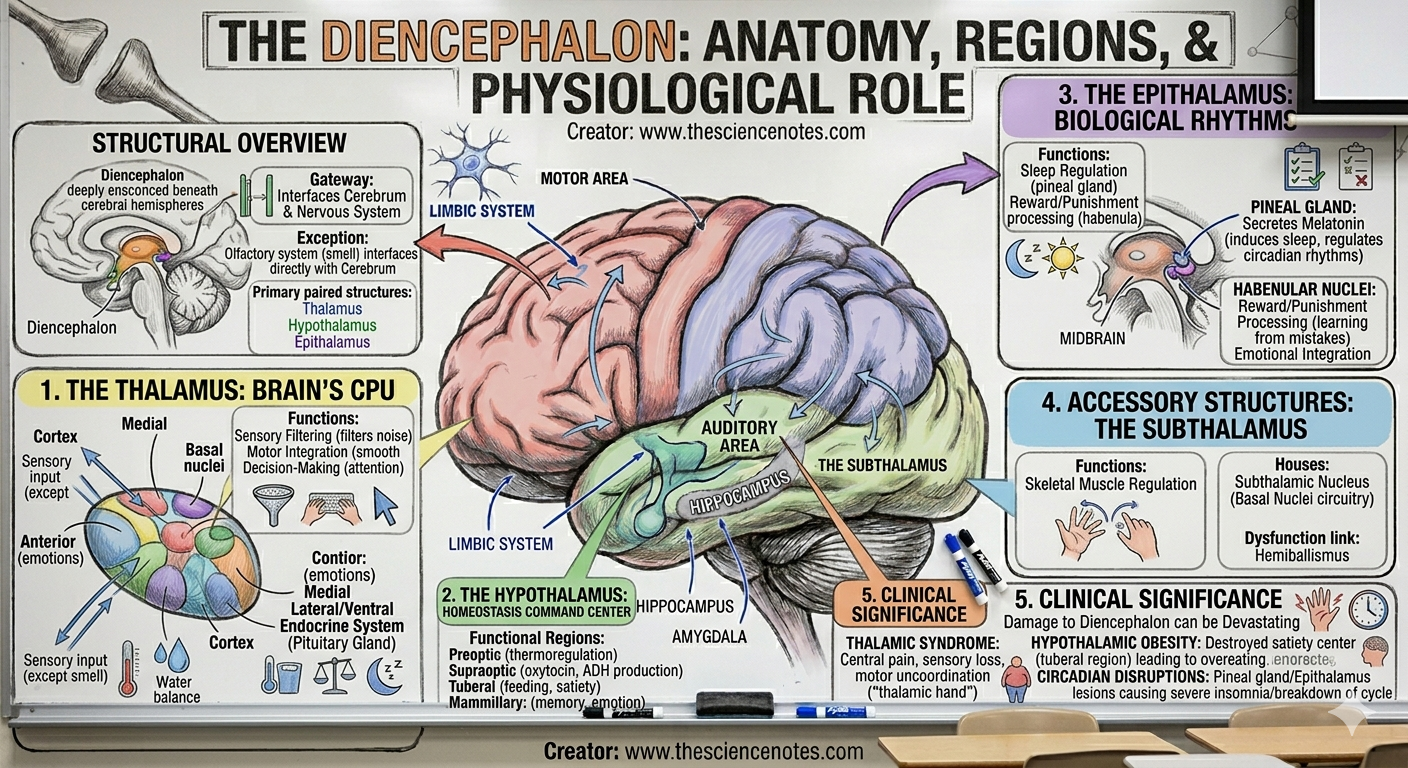
1. The Thalamus: The Brain’s Central Processing Unit
The thalamus is a massive, oval-shaped paired structure that accounts for about 80% of the diencephalon. It is far more than a passive relay station; it is a sophisticated “gatekeeper” that decides which pieces of information are important enough to reach our conscious awareness.
Sensory and Motor Relay
All sensory information (excluding olfaction) is routed through specific nuclei in the thalamus before reaching the cerebral cortex.
Sensory Filtering: Thalamic neurons dictate which stimuli warrant attention. For example, if you are focusing on a book, your thalamus filters out background noise so the auditory signals do not distract the visual cortex.
Motor Integration: The thalamus receives motor commands from the cerebellum and basal nuclei. It processes these signals and relays them to the motor cortex to ensure smooth, coordinated movement.
Organization of Thalamic Nuclei
The thalamus is organized into several distinct groups of nuclei based on their position:
Anterior & Medial Groups: Involved in emotions, memory, and awareness.
Lateral & Ventral Groups: Primarily handle sensory relay (visual, auditory, and somatic) and motor coordination.
Reticular Nuclei: These wrap around the lateral aspect of the thalamus and help regulate the activity of other thalamic nuclei, playing a key role in maintaining consciousness.
2. The Hypothalamus: The Command Center for Homeostasis
Positioned anterior and slightly below the thalamus, the hypothalamus is small in size but monumental in function. It is the primary link between the nervous system and the endocrine system, serving as the body’s “thermostat” and master regulator.
Control of the Autonomic and Endocrine Systems
The hypothalamus maintains internal balance (homeostasis) through two main pathways:
The Autonomic Nervous System (ANS): It governs involuntary functions like heart rate, blood pressure, and digestion.
The Endocrine System: By regulating the pituitary gland, the hypothalamus controls the release of hormones that influence growth, metabolism, and reproduction.
Functional Regions of the Hypothalamus
The hypothalamus is divided into four major regions, each containing vital nuclei:
Preoptic Region: Involved in thermoregulation (shivering or sweating).
Supraoptic Region: Houses nuclei that produce hormones like oxytocin and ADH (antidiuretic hormone), which regulates fluid balance.
Tuberal Region: Controls food ingestion, satiety, and energy balance.
Mammillary Region: Contains the mammillary bodies, which are part of the limbic system and are essential for memory and emotional responses.
3. The Epithalamus: Regulation of Biological Rhythms
The epithalamus is the most posterior and smallest part of the diencephalon. Despite its size, it performs essential tasks related to sleep, emotion, and the processing of rewards.
The Pineal Gland and Melatonin
The most prominent feature of the epithalamus is the pineal gland. This gland secretes melatonin, a hormone that induces sleep. Working in close coordination with the hypothalamus, the pineal gland helps regulate our circadian rhythms (the 24-hour sleep-wake cycle).
The Habenular Nuclei
The epithalamus also contains the habenular nuclei. These nuclei act as a bridge between the limbic system (emotions) and the midbrain.
Reward Processing: Research suggests the habenula influences behavior by processing “punishment” or negative rewards. It helps the brain learn from mistakes by signaling when an outcome is worse than expected.
Emotional Integration: It integrates sensory input with emotional states, helping to coordinate visceral and emotional responses to the environment.
4. Accessory Structures: The Subthalamus
Beneath the thalamus lies the subthalamus. Though often categorized separately, it is functionally part of the diencephalic complex. It houses the subthalamic nucleus, which is a critical component of the basal nuclei circuitry. This area is vital for regulating skeletal muscle movements; dysfunction here is often linked to movement disorders like hemiballismus.
5. Clinical Significance of the Diencephalon
Because the diencephalon is the central hub for sensory, motor, and homeostatic signals, damage to this area can be devastating.
Thalamic Syndrome: Damage to the thalamus can lead to “central pain,” where the brain misinterprets ordinary touch as severe, burning pain. It can also cause sensory loss or “thalamic hand,” where motor coordination is lost.
Hypothalamic Obesity: Damage to the tuberal region can destroy the satiety center, leading to uncontrollable overeating and rapid weight gain.
Circadian Disruptions: Lesions in the epithalamus or pineal gland can lead to severe insomnia or a complete breakdown of the sleep-wake cycle.
Conclusion
The diencephalon is the ultimate intersection of the human body and the human mind. By housing the thalamus, hypothalamus, and epithalamus, it manages everything from our conscious perception of the world to our most basic survival instincts, such as hunger, thirst, and sleep. Understanding these anatomical regions is essential for grasping how the brain maintains internal stability while simultaneously processing the complex sensory data of the external world.
