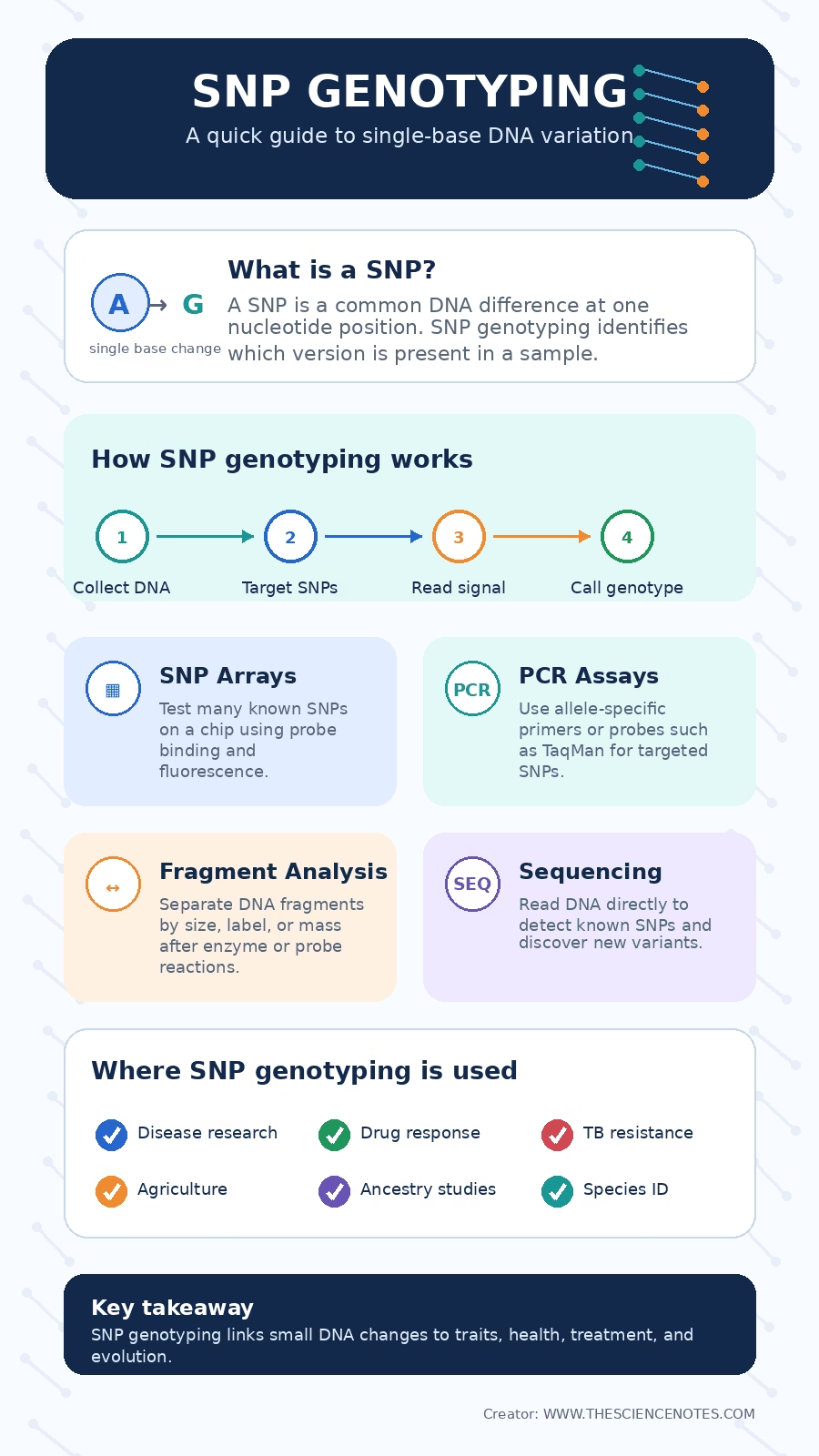
Single nucleotide polymorphisms, or SNPs, are among the most common forms of genetic variation. They occur when one DNA base differs at a specific position in the genome. For example, one person may have an A at a certain DNA location, while another person may have a G at the same location.
These small DNA differences matter. They can help scientists study disease risk, drug response, ancestry, population history, and inherited traits. Some SNPs affect health directly. Many others act as markers that help researchers locate nearby disease-related genes.
SNP genotyping is the process of finding out which SNP variants a person, organism, or sample carries. Researchers use this process in medicine, genetic research, agriculture, microbiology, and public health.
A SNP usually refers to a single-base DNA variant that appears in at least 1% of a population. SNPs are the most common type of genetic variation among people, and they may help predict disease risk or drug response in some cases.
What Is a SNP?
A SNP is a change at one DNA base. DNA uses four bases: adenine, thymine, cytosine, and guanine. Scientists often write them as A, T, C, and G.
A simple example looks like this:
- Person 1: AAGCCTA
- Person 2: AAGCTTA
Only one base differs. That difference is a SNP if it appears often enough in a population.
SNPs can appear almost anywhere in the genome. Some occur inside genes. Others occur outside genes. Some appear in regions that help control gene activity. Many SNPs have no clear effect on health or traits.
Still, SNPs remain useful. A SNP can act like a signpost in the genome. Even if it does not cause disease, it may sit close to a disease-causing variant. Researchers can then use that SNP to help find the important region.
Medical genetics databases also track SNPs and other small variants. NCBI’s dbSNP database stores submitted variants, nearby DNA sequences, population information, and frequency data when available.
What Is SNP Genotyping?
SNP genotyping means identifying which version of a SNP appears in a DNA sample. In humans, most autosomal DNA regions come in two copies. One copy comes from each parent.
If a SNP has two possible alleles, such as C and T, a person may have one of three genotypes:
- CC
- CT
- TT
This result may look simple. Yet it can support many kinds of research and clinical work.
Scientists may genotype one SNP, a small group of SNPs, or millions of SNPs at once. The choice depends on the goal. A clinic may test a few drug-response variants. A research team may test hundreds of thousands of SNPs in a genome-wide association study.
SNP genotyping can also help researchers compare groups. It can show how variants differ between populations, disease groups, species, or pathogen strains.
Why SNP Genotyping Matters
SNP genotyping matters because it connects DNA variation with real-world traits. These traits may include disease risk, medication response, crop yield, bacterial drug resistance, or inherited physical features.
In medicine, SNPs can help researchers identify genes linked to disease. Drug research, they can help explain why one patient responds well to a drug while another does not. In microbiology, SNPs can help track bacterial strains and resistance mutations.
SNPs also support large databases and research tools. For example, dbSNP now contains more than one billion human Reference SNP records. This large catalog helps researchers design assays, compare variants, and interpret genomic data.
The value of SNP genotyping comes from scale. One SNP may offer limited information. Thousands or millions of SNPs can reveal patterns across the genome.
SNPs, Haplotypes, and Linkage Disequilibrium
To understand SNP genotyping, it helps to understand haplotypes and linkage disequilibrium.
A haplotype is a group of DNA variants that tend to travel together through inheritance. Linkage disequilibrium, often called LD, means that certain alleles appear together more often than chance would predict.
This happens because nearby DNA variants often sit on the same chromosome segment. That segment may pass from parent to child as a block.
Because of LD, researchers do not always need to test every SNP in a region. A single SNP can “tag” a larger DNA block. This tag can help identify a region linked to a disease or trait.
This idea powers many genetic association studies. It also lowers cost. Instead of sequencing every base in every person, researchers can genotype selected SNPs that represent larger genomic regions.
SNP Genotyping and Disease Research
Researchers use SNP genotyping to study many diseases. These include diabetes, heart disease, autoimmune disease, cancer, and neurological conditions.
Many common diseases do not come from one gene alone. They often involve many genes and environmental factors. Each genetic variant may add only a small amount of risk.
SNP genotyping helps researchers detect those small effects. It also helps them identify biological pathways that deserve closer study.
In many cases, a disease-linked SNP does not cause disease directly. Instead, it marks a nearby region that contains the functional variant. Researchers then use fine mapping, sequencing, and lab experiments to find the true biological cause.
The GWAS Catalog notes that many variants found by genome-wide association studies likely tag regions of linkage disequilibrium rather than act as direct causal variants.
Genome-Wide Association Studies
A genome-wide association study, or GWAS, scans many SNPs across the genome. Researchers then test whether any SNP appears more often in people with a disease or trait than in people without it.
A GWAS can include hundreds of thousands or millions of SNPs. It can also include thousands or millions of participants.
The goal is not only to find risk markers. Researchers also want to learn how diseases develop. A strong GWAS result may point to a gene, pathway, or cell type that needs further study.
The NHGRI-EBI GWAS Catalog stores curated GWAS findings. A recent update described the Catalog as a public knowledgebase with data from more than 45,000 published GWAS across more than 5,000 human traits.
GWAS has changed human genetics. Yet it also has limits. Most findings need replication. Many associated SNPs have small effects. Researchers must also account for ancestry, sample quality, and population structure.
Main SNP Genotyping Methods
Scientists have developed many SNP genotyping methods. The best method depends on the number of SNPs, the sample type, the budget, and the question.
Most methods fall into four broad groups:
- Direct hybridization
- PCR-based methods
- Fragment analysis
- DNA sequencing
Each method has strengths. Each method also has trade-offs. A high-throughput SNP array can test millions of variants. A targeted PCR assay can test one important SNP quickly. Sequencing can find both known and new variants.
Direct Hybridization and SNP Arrays
Direct hybridization methods use short DNA probes. These probes bind to specific DNA sequences. If a probe matches the sample DNA, it produces a signal.
SNP arrays use this idea at large scale. A chip may contain hundreds of thousands or millions of probes. Each probe targets a known SNP allele.
A typical SNP array workflow includes several steps. First, researchers isolate DNA. Then they amplify and fragment it. Next, they label the DNA, often with a fluorescent marker. The DNA then binds to probes on the chip. A scanner reads the signal.
SNP arrays work well when researchers need to test many known variants. They support GWAS, ancestry studies, biobank research, agricultural breeding, and sample quality control.
Sequence-specific oligonucleotide probes can detect SNPs because a perfect match binds more strongly than a sequence with a single-base mismatch. Researchers use this principle in DNA microarrays and other hybridization assays.
Strengths and Limits of SNP Arrays
SNP arrays offer high throughput. They can genotype many SNPs in many samples at once. They also cost less than whole-genome sequencing for many large studies.
Arrays work best for known variants. This makes them useful when a research team already knows which SNPs matter.
However, arrays do not detect every possible variant. They may miss rare variants, new mutations, or population-specific variants that do not appear on the chip. They may also perform less well when probe binding changes because of nearby sequence differences.
For this reason, researchers often use arrays for discovery studies and sequencing for deeper follow-up.
PCR-Based SNP Genotyping
PCR-based methods amplify a target DNA region. Then they detect which allele appears at a SNP site.
These methods work well when researchers want to test a small number of SNPs. They are common in clinical labs, research labs, agriculture, and pathogen testing.
One common method is allele-specific PCR. In this method, primers match one allele better than the other. If the primer matches the sample, amplification occurs. If it does not match, amplification fails or becomes weaker.
Another common method is TaqMan PCR. This method uses fluorescent probes. Each probe targets a specific allele. During PCR, the correct probe produces a fluorescent signal. The instrument reads the signal and assigns the genotype.
Studies comparing PCR-based SNP genotyping methods show clear trade-offs. ARMS-PCR can offer a simple and low-cost option, while TaqMan qPCR can provide speed and sensitivity at a higher probe cost.
TaqMan and Assay Validation
TaqMan assays remain popular because they are fast and scalable. Labs can use them for many targeted SNP tests. They also work well in real-time PCR systems.
Still, every assay needs validation. A nearby variant may affect primer or probe binding. A complex gene may create unexpected results. This matters in genes with many similar sequences or many variants.
One study on CYP2D6 SNP genotyping showed that TaqMan assays can produce unexpected calls in complex pharmacogenetic regions. The authors stressed the need for careful validation across diverse genotypes.
This point matters for clinical testing. A genotype result may guide treatment. So the lab must confirm that the assay performs well in the intended population and sample type.
Fragment Analysis Methods
Fragment analysis methods identify SNPs by creating DNA fragments that differ by size, label, or mass.
One classic method is restriction fragment length polymorphism analysis, or RFLP. This method uses restriction enzymes. These enzymes cut DNA at specific sequences. If a SNP creates or removes a cutting site, each allele produces a different fragment pattern.
Another method is the ligation assay. It uses two probes that bind next to each other. One probe ends at the SNP position. If the base matches perfectly, ligation occurs. If it does not match, ligation fails.
A third method is the primer extension assay. A primer binds just before the SNP. The reaction adds a nucleotide based on the allele in the sample. Researchers then measure the extension product.
Labs can separate these products with gel electrophoresis, capillary electrophoresis, or mass spectrometry.
Fragment analysis can work well for targeted testing. It also helps when a lab needs a lower-cost method for a small number of variants.
DNA Sequencing for SNP Genotyping
Sequencing can identify known SNPs and discover new variants. This makes it more flexible than many targeted methods.
Sanger sequencing works well for small regions. Researchers often use it to confirm a variant found by another method.
Next-generation sequencing can analyze gene panels, exomes, genomes, or microbial isolates. It can detect SNPs, small insertions, small deletions, and sometimes larger changes.
Sequencing also gives more context. It can show nearby variants, haplotypes, and unexpected changes in the same region.
However, sequencing requires careful data analysis. Read depth, base quality, mapping quality, and software choices can affect results. In one whole-genome sequencing study, higher depth improved genotype concordance, and more than 13.7× depth reached greater than 99% concordance in the tested data.
Variant Calling and Quality Control
Sequencing does not automatically produce perfect genotypes. The raw data contain read errors. Some reads align to the wrong genomic region. Some variants appear hard to call, especially in repeated or complex DNA.
Variant calling software helps separate true variants from noise. Different pipelines may produce different results. This creates a need for benchmarking and quality control.
A systematic comparison of variant calling pipelines found that callers can show different biases in SNP genotyping errors. The study highlighted the need for reliable pipelines in clinical genomics.
Quality control also matters in SNP arrays and PCR assays. Researchers check call rates, missing data, Hardy-Weinberg equilibrium, sample identity, ancestry outliers, and batch effects.
Good data quality protects the whole study. Poor data can create false links or hide real ones.
How Labs Choose a SNP Genotyping Method
No single SNP genotyping method fits every project. Labs choose based on the goal.
A research team may choose a SNP array for a GWAS because it needs genome-wide coverage. A clinical lab may choose PCR because it needs a quick answer for a small pharmacogenomic panel. A microbiology lab may choose sequencing because it needs to detect known and emerging resistance mutations.
Cost also matters. Arrays and PCR often cost less than deep sequencing. Sequencing gives richer data but needs more analysis.
Sample quality matters too. Some samples contain little DNA. Others contain degraded DNA. A method that works well for fresh blood may not work as well for fixed tissue or old samples.
The right choice balances accuracy, cost, speed, throughput, and clinical or research value.
SNP Genotyping in Personalized Medicine
Personalized medicine aims to match care to the person. SNP genotyping helps by showing genetic differences that affect disease risk or drug response.
In pharmacogenomics, clinicians may use genotype information to guide drug choice or dose. A variant may affect how fast a person breaks down a drug. Another variant may affect drug targets or toxicity risk.
The FDA states that pharmacogenomic information in drug labeling may describe drug exposure, clinical response, adverse event risk, genotype-specific dosing, and polymorphic drug targets or disposition genes.
The FDA also notes that pharmacogenetic tests, along with other patient information, can help guide therapeutic strategy, dosage, and likely benefit or toxicity.
This does not mean every drug needs SNP testing. It means SNP genotyping can help when strong evidence links a variant to drug response.
Clinical Pharmacogenomics Is Growing
Health systems now explore ways to bring pharmacogenomics into routine care. Some programs test patients before they need certain drugs. This approach is called preemptive testing.
A 2024 academic medical center report described a pharmacogenomics program that covered 56 medications and 15 genes. The team added pharmacogenomic alerts and testing prompts into the electronic health record.
This kind of system can help clinicians act on genotype results at the point of care. It can also reduce the chance that useful genetic information gets ignored.
Still, implementation remains difficult. Health systems need clear guidelines, trained staff, reliable testing, privacy safeguards, and decision support tools.
SNP Genotyping in Tuberculosis and Drug Resistance
SNP genotyping also supports infectious disease control. Pathogens can gain mutations that change drug response, spread, or virulence.
Tuberculosis provides a strong example. TB genotyping analyzes the DNA of Mycobacterium tuberculosis. Public health teams use it with epidemiologic data to identify possible transmission chains.
Whole-genome sequencing now gives public health teams much more detail. CDC notes that older conventional TB genotyping methods examined less than 1% of the genome. Whole-genome sequencing can examine more than 90%.
This matters because SNP differences can help show whether TB cases may connect through recent transmission. They can also help detect mutations linked to drug resistance.
Molecular Detection of TB Resistance
Drug-resistant TB needs fast detection. Delays can lead to poor treatment and more transmission.
CDC’s Molecular Detection of Drug Resistance service uses DNA sequencing to detect mutations linked to resistance. CDC explains that TB drug resistance often comes from mutations in specific genes. Many of these changes involve a single nucleotide.
For example, mutations in the rpoB region can indicate rifampin resistance. Rifampin is one of the most important TB drugs. Detecting resistance early can help clinicians adjust treatment sooner.
Molecular tests do not replace every traditional test. Growth-based drug susceptibility testing still matters. But molecular results can speed up decisions when time matters.
SNP Genotyping in Agriculture and Species Identification
SNP genotyping also plays a major role outside human medicine. Breeders use SNPs to study crops and livestock. Conservation scientists use them to study populations. Food testing labs can use them to verify species or varieties.
In agriculture, SNPs can help identify traits such as disease resistance, yield, milk production, drought tolerance, or growth rate. Breeders can then select plants or animals with favorable genotypes.
Sequencing-based genotyping methods can produce thousands to millions of SNPs across many species. A comparison of genotyping-by-sequencing pipelines found that several methods produced high accuracy, while the number of called variants depended on the pipeline and reference genome strategy.
SNP genotyping can also distinguish organisms that look nearly identical. This helps in seed authentication, breed verification, pathogen tracking, and biodiversity studies.
Benefits of SNP Genotyping
SNP genotyping offers several clear benefits.
First, it provides a practical way to measure genetic variation. Labs can test one SNP or millions of SNPs.
Second, it supports large-scale research. GWAS, biobanks, and population studies all depend on reliable SNP data.
Third, it can guide clinical decisions in selected cases. Pharmacogenomic testing is one of the clearest examples.
Fourth, it helps public health teams track pathogens. SNP data can support outbreak detection and drug resistance surveillance.
Fifth, it can reduce costs. Researchers can use tag SNPs to study larger genomic regions without sequencing every base.
These benefits explain why SNP genotyping remains a core tool in modern genomics.
Limitations of SNP Genotyping
SNP genotyping also has limits.
A SNP association does not prove causation. A disease-linked SNP may only mark a nearby causal variant. Researchers need follow-up studies to prove biological function.
Population differences can also affect interpretation. A SNP linked to a trait in one ancestry group may not have the same meaning in another group. This can happen because LD patterns and allele frequencies differ across populations.
Assay design can create errors. Nearby variants may affect probe binding. Low DNA quality can reduce accuracy. Batch effects can create false patterns.
GWAS data also need strict quality control. Researchers must check sample identity, relatedness, population structure, marker quality, and other issues before analysis.
Clinical use needs extra care. A result may affect treatment, family decisions, or anxiety. Patients and clinicians need clear interpretation.
The Future of SNP Genotyping
SNP genotyping continues to evolve. Arrays remain useful for large known-variant studies. PCR remains useful for targeted and fast testing. Sequencing keeps expanding because it can detect both known and novel variants.
The field now moves toward integration. Researchers combine SNP data with gene expression, epigenetics, proteomics, health records, and environmental data. This can provide a fuller view of disease and drug response.
GWAS resources also keep growing. The NHGRI-EBI GWAS Catalog now includes sequencing-based GWAS, gene-based analyses, and copy number variation analyses. This reflects the shift toward richer and more diverse genomic data.
In healthcare, the future depends on actionability. Genotyping alone is not enough. Clinicians need clear guidance, strong evidence, and decision support.
In public health, faster sequencing may help detect outbreaks and resistance sooner. In agriculture, SNP tools may support faster breeding and more resilient food systems.
FAQ: SNP Genotyping
What does SNP genotyping mean?
SNP genotyping means testing DNA to find which allele appears at a specific SNP position. The result may show whether a person has two copies of one allele or one copy of each allele.
Is SNP genotyping the same as genetic testing?
SNP genotyping is one type of genetic testing. Genetic testing can also include sequencing, chromosome analysis, copy number testing, and other methods.
Can SNP genotyping predict disease?
Sometimes it can help estimate risk. But most common diseases involve many genes and non-genetic factors. A SNP result rarely gives a simple yes-or-no answer.
Can SNP genotyping guide medication use?
Yes, in selected cases. Pharmacogenomic SNPs and other genetic variants can affect drug metabolism, response, or toxicity. Clinicians should use validated tests and clinical guidelines.
Which method is best for SNP genotyping?
The best method depends on the task. SNP arrays work well for large known-variant studies. PCR works well for targeted SNPs. Sequencing works well when researchers need broader detail or novel variant discovery.
Conclusion
SNP genotyping turns small DNA differences into useful information. It helps researchers study disease, drug response, inheritance, ancestry, agriculture, and pathogen evolution.
The field includes several major methods. SNP arrays offer high-throughput testing of known variants. PCR-based assays provide fast and targeted results. Fragment analysis supports smaller variant panels. Sequencing gives deeper detail and can detect new variants.
SNP genotyping does not answer every genetic question. It needs strong study design, careful assay validation, and clear interpretation. Yet it remains one of the most useful tools in genomics.
As databases grow and sequencing costs fall, SNP genotyping will keep shaping medicine, research, agriculture, and public health.
Citations
- 1.Definition of single nucleotide polymorphism – NCI Dictionary of Genetics Terms – NCI
 National Cancer Institute
 - 2.dbSNP: a database of single nucleotide polymorphismsNucleic Acids Research2000Elizabeth M Smigielski, et al.
- 3.Single Nucleotide Polymorphism Database (dbSNP) Archives – NCBI Insightsncbiinsights.ncbi.nlm.nih.gov
- 4.Genome-wide association studies and genetic testing: understanding the science, success, and future of a rapidly developing fieldJournal of the American Veterinary Medical Association2019Lauren Baker, et al.
- 5.The new NHGRI-EBI Catalog of published genome-wide association studies (GWAS Catalog)Nucleic Acids ResearchJan 2017Jacqueline MacArthur, et al.
- 6.The NHGRI-EBI GWAS Catalog: knowledgebase and deposition resourceNucleic Acids ResearchJan 2023Elliot Sollis, et al.
- 7.Sequence-Specific Oligonucleotide (SSO) Probesncbi.nlm.nih.govNov 2017
- 8.PCR-based SNP genotyping: A comprehensive comparison of methods for affordable and accurate detection of class IV mutations.Analytica Chimica Acta2025Kajan Muneeswaran, et al.
- 9.SNP genotyping using TaqMan technology: the CYP2D6*17 assay conundrum.Scientific Reports2015Andrea Gaedigk, et al.
- 10.Empirical evaluation of variant calling accuracy using ultra-deep whole-genome sequencing data.Scientific Reports2019Toshihiro Kishikawa, et al.
- 11.Systematic comparison of variant calling pipelines using gold standard personal exome variants.
