A trihybrid cross is a genetic cross that studies the inheritance of three traits at the same time. Students usually learn this topic after monohybrid and dihybrid crosses because it builds on both ideas.
In a monohybrid cross, scientists study one trait. In a dihybrid cross, they study two traits. However, in a trihybrid cross, they study three traits together. For example, a trihybrid cross in pea plants may examine plant height, seed shape, and seed color.
Gregor Mendel used pea plants to study how traits pass from parents to offspring. His work showed that parents pass separate hereditary factors to their offspring. Today, we call these factors genes. Different forms of a gene are called alleles.
Trihybrid crosses help students understand how several traits can pass from one generation to the next. In addition, they show why probability becomes important in genetics.
What Is a Trihybrid Cross?
A trihybrid cross involves three different traits. Each trait usually has one dominant allele and one recessive allele.
For example, a common pea plant trihybrid cross includes:
| Trait | Dominant Allele | Recessive Allele |
|---|---|---|
| Plant height | T = tall | t = short |
| Seed shape | R = round | r = wrinkled |
| Seed color | Y = yellow | y = green |
A plant with the genotype TTRRYY has all dominant alleles. Therefore, it is tall and produces round, yellow seeds.
A plant with the genotype ttrryy has all recessive alleles. As a result, it is short and produces wrinkled, green seeds.
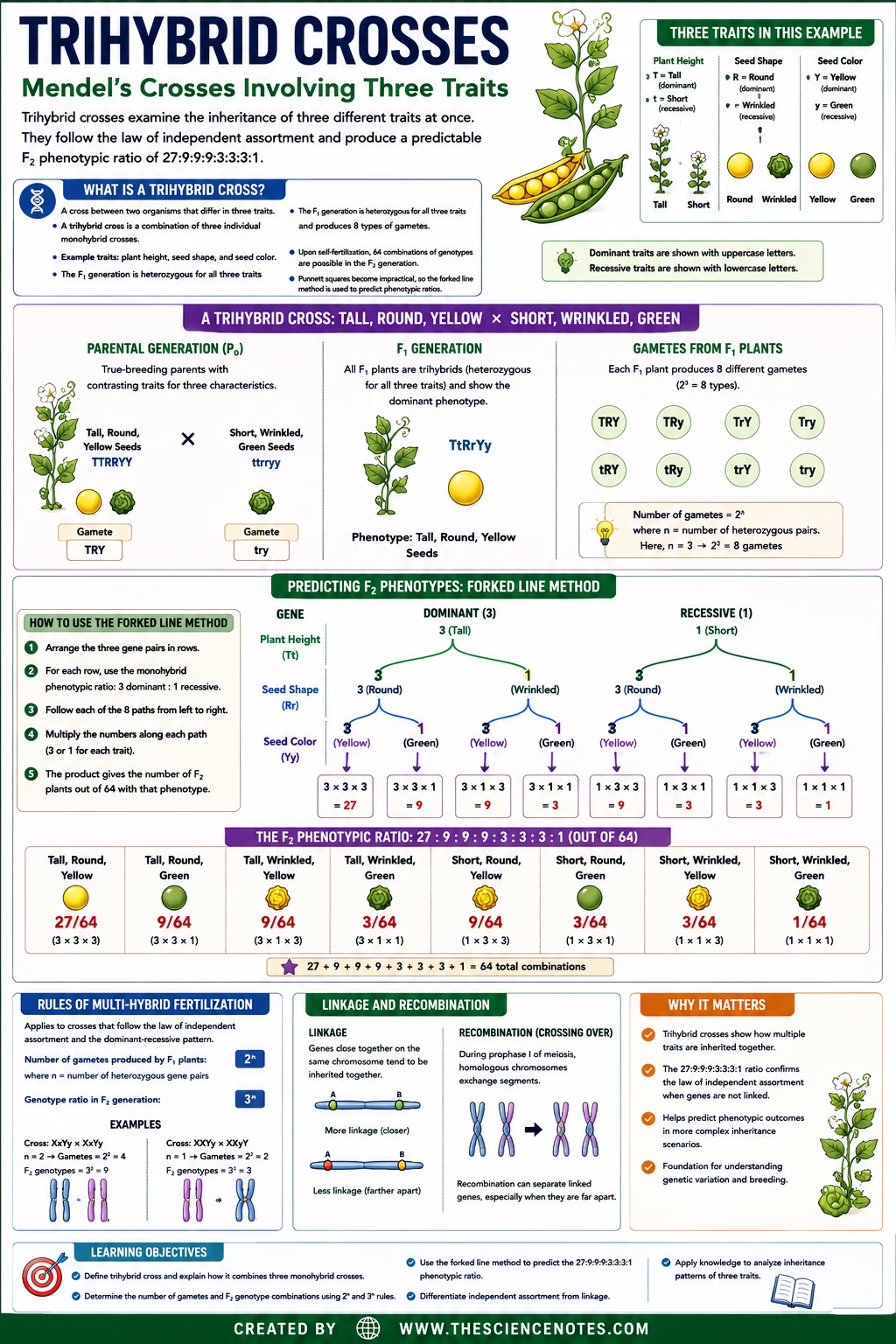
Parental Generation in a Trihybrid Cross
The first plants in a genetic cross are called the parental generation, or P generation.
In this example, the parental cross is:
TTRRYY × ttrryy
The first parent can produce only one type of gamete:
TRY
The second parent can produce only one type of gamete:
try
When these gametes combine, every offspring receives one dominant allele and one recessive allele for each trait. Therefore, all offspring in the F1 generation have the genotype:
TtRrYy
These offspring are called trihybrids because they are heterozygous for all three traits.
The F1 Generation
The F1 generation is the first generation of offspring. In this cross, all F1 plants have the genotype:
TtRrYy
Because tall height, round seed shape, and yellow seed color are dominant, every F1 plant shows the dominant phenotype.
The F1 phenotype is:
Tall plant with round, yellow seeds
Even though these plants carry recessive alleles, the recessive traits do not appear. Instead, the dominant alleles mask them.
This result follows the same pattern seen in simpler Mendelian crosses. For example, a heterozygous plant usually shows the dominant trait when complete dominance occurs.
Gametes Produced by F1 Trihybrids
Next, students need to determine how many gametes the F1 plants can produce.
The formula is:
Number of gamete types = 2ⁿ
In this formula, n means the number of heterozygous gene pairs.
For the genotype TtRrYy, there are three heterozygous gene pairs:
- Tt
- Rr
- Yy
So the number of gamete types is:
2³ = 8
The eight possible gametes are:
| Possible Gametes |
|---|
| TRY |
| TRy |
| TrY |
| Try |
| tRY |
| tRy |
| trY |
| try |
Each gamete receives one allele for plant height, one allele for seed shape, and one allele for seed color. As a result, the F1 plants can produce many allele combinations.
Why a Punnett Square Becomes Difficult
A Punnett square works well for simple genetic crosses. For instance, a monohybrid cross uses a 2 × 2 Punnett square. A dihybrid cross uses a 4 × 4 Punnett square.
However, a trihybrid cross requires an 8 × 8 Punnett square. That means the square contains:
64 boxes
Each box represents one possible fertilization outcome in the F2 generation.
Because this table is large, it can become difficult to draw and read. For this reason, students often use the forked line method instead.
What Is the Forked Line Method?
The forked line method is a simpler way to predict phenotype ratios in multi-trait crosses. Instead of drawing a large Punnett square, students treat the trihybrid cross as three separate monohybrid crosses.
For the cross:
TtRrYy × TtRrYy
each trait follows a 3:1 phenotypic ratio:
| Trait | Cross | Phenotypic Ratio |
|---|---|---|
| Plant height | Tt × Tt | 3 tall : 1 short |
| Seed shape | Rr × Rr | 3 round : 1 wrinkled |
| Seed color | Yy × Yy | 3 yellow : 1 green |
Then, students multiply the values along each path.
For example, the path for tall, round, yellow is:
3 × 3 × 3 = 27
Therefore, 27 out of 64 expected F2 offspring will be tall with round, yellow seeds.
F2 Phenotypic Ratio in a Trihybrid Cross
When F1 trihybrids self-fertilize, the cross becomes:
TtRrYy × TtRrYy
This cross produces eight possible phenotype combinations in the F2 generation.
The expected phenotypic ratio is:
27:9:9:9:3:3:3:1
| F2 Phenotype | Expected Ratio | Fraction |
|---|---|---|
| Tall, round, yellow | 27 | 27/64 |
| Tall, round, green | 9 | 9/64 |
| Tall, wrinkled, yellow | 9 | 9/64 |
| Short, round, yellow | 9 | 9/64 |
| Short, wrinkled, yellow | 3 | 3/64 |
| Short, round, green | 3 | 3/64 |
| Tall, wrinkled, green | 3 | 3/64 |
| Short, wrinkled, green | 1 | 1/64 |
The largest group shows all three dominant traits. By contrast, the smallest group shows all three recessive traits.
This ratio appears when the genes assort independently and follow a dominant-recessive inheritance pattern.
Rules of Multi-Hybrid Fertilization
Multi-hybrid crosses follow useful mathematical rules. These rules help students solve crosses faster.
Number of Gametes
Use this formula:
2ⁿ
Here, n is the number of heterozygous gene pairs.
Examples:
| Genotype | Heterozygous Pairs | Gamete Types |
|---|---|---|
| XxYy | 2 | 2² = 4 |
| XXYy | 1 | 2¹ = 2 |
| TtRrYy | 3 | 2³ = 8 |
Only heterozygous gene pairs count. For example, XX does not add variation because it can pass on only X.
Number of F2 Genotype Classes
Use this formula:
3ⁿ
Again, n is the number of heterozygous gene pairs.
For a trihybrid cross:
3³ = 27 genotype classes
This means the F2 generation can contain 27 genotype categories.
Independent Assortment in Trihybrid Crosses
Trihybrid crosses depend on Mendel’s Law of Independent Assortment.
This law states that alleles for different genes separate independently during gamete formation, as long as the genes are not linked.
In the genotype TtRrYy, the allele for plant height does not control which allele the plant passes on for seed shape or seed color. Therefore, the F1 plant can produce eight different gamete types.
This process creates genetic variation. In other words, offspring can inherit trait combinations that differ from both parents.
Linkage and Recombination
The expected trihybrid ratio assumes that the three genes assort independently. However, real genes do not always behave this way.
Genes that sit close together on the same chromosome may travel together into the same gamete. Scientists call this linkage.
During meiosis, chromosomes can exchange matching DNA segments. This process is called recombination or crossing over. Recombination can separate linked genes, especially when the genes are far apart on the chromosome.
In general, genes on different chromosomes assort independently. Genes far apart on the same chromosome may also behave almost independently. However, genes close together on the same chromosome often show linkage.
Why Trihybrid Crosses Matter
Trihybrid crosses help students see how inheritance becomes more complex as more traits are added. At the same time, they show that simple probability rules can still predict many genetic outcomes.
Students use trihybrid crosses to learn how to:
- Predict three-trait inheritance patterns
- Calculate gamete types with 2ⁿ
- Understand why F2 generations can produce 64 fertilization outcomes
- Use the forked line method instead of a large Punnett square
- Explain the 27:9:9:9:3:3:3:1 ratio
- Compare independent assortment with linkage
- Connect Mendelian genetics to meiosis
For educators, this topic also provides a strong bridge to advanced genetics. For example, teachers can use it before introducing recombination frequency, chromosome mapping, and non-Mendelian inheritance.
Conclusion
A trihybrid cross studies the inheritance of three traits at the same time. In a classic example, a tall plant with round, yellow seeds crosses with a short plant with wrinkled, green seeds.
The F1 generation becomes heterozygous for all three traits and shows the dominant phenotype. These F1 plants have the genotype TtRrYy and can produce eight types of gametes.
When F1 trihybrids self-fertilize, the F2 generation can produce 64 fertilization combinations. Because an 8 × 8 Punnett square is difficult to use, students often choose the forked line method.
Finally, when the genes assort independently, the expected F2 phenotypic ratio is:
27:9:9:9:3:3:3:1
This ratio shows how probability explains the inheritance of three traits. However, linkage and recombination can change this pattern in real organisms.
