Skip to content

THE SCIENCE NOTES

Complex Science, Simplified.

  • Home
  • Anatomy and Physiology
  • Biochemistry
  • Biotechnology
  • Cancer
  • Cell and Molecular Biology
  • Diseases Guide
  • Genetics
  • Immunology
  • Microbiology
  • Food Science
  • Cell and Molecular Biology
  • Protocols and Techniques
  • Microbiology
  • Privacy Policy
  • Contact Us
THE SCIENCE NOTES
  • Home
  • Anatomy and Physiology
  • Biochemistry
  • Biotechnology
  • Cancer
  • Cell and Molecular Biology
  • Diseases Guide
  • Genetics
  • Immunology
  • Microbiology
  • Food Science
  • Cell and Molecular Biology
  • Protocols and Techniques
  • Microbiology
  • Privacy Policy
  • Contact Us

Day: June 3, 2026

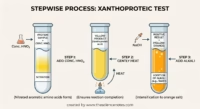
The diagram shows three sequential test tubes illustrating the qualitative analysis of proteins containing aromatic amino acids. Step 1 shows a test tube labeled "NITRATION" where concentrated nitric acid ($HNO_3$) is added to a protein sample, beginning to form a light yellow color representing nitrated aromatic amino acids. Step 2 shows the test tube being gently heated over a small burner flame, producing a distinct yellow substance labeled "Xanthoproteic Acid" to ensure reaction completion. Step 3 shows sodium hydroxide ($NaOH$) alkali being added via a dropper, resulting in a dark yellow-orange positive result due to the intensification into an orange salt.
Posted on June 3, 2026 Biochemistry Protocols and Techniques

Xanthoproteic Test: Qualitative Protein Analysis Using Nitric Acid

Learn how the xanthoproteic test uses nitric acid to detect aromatic amino acids in proteins, including principle, procedure, results, uses, and limitations. Read more
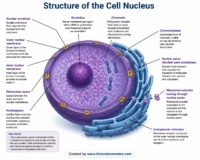
Labeled diagram of a eukaryotic cell nucleus showing the nuclear envelope, outer nuclear membrane, inner nuclear membrane, perinuclear space, nuclear pore complexes, nucleoplasm, nucleolus, chromatin, chromosomes, ribosomal subunits exiting through nuclear pores, and the endoplasmic reticulum connected to the outer nuclear membrane.
Posted on June 3, 2026 Biology

Nucleus: Definition, Structure, Functions, DNA Organization, and Diagram

The nucleus is a membrane-bound organelle that stores DNA and controls gene expression in eukaryotic cells. Learn its structure, nucleolus, chromatin, chromosomes, nuclear pores, and functions. Read more

Recent Posts

  • Xanthoproteic Test: Qualitative Protein Analysis Using Nitric Acid
  • Nucleus: Definition, Structure, Functions, DNA Organization, and Diagram
  • RNA-Seq: Principles, Workflow, Data Analysis, and Applications in Transcriptomics
  • SNP Genotyping: Methods, Applications, and Benefits
  • Genetic Screens: Types, Methods, and Applications

🔥 Trending Now

  • 01 M1 and M2 Macrophage Polarization Protocol
  • 02 Health Impacts of Microplastics: A Complete Guide
  • 03 Entamoeba histolytica: Lifecycle and Diagnosis
Advertisement
June 2026
SMTWTFS
 123456
78910111213
14151617181920
21222324252627
282930 
« May    
Advertisement

Two things are infinite: the universe and human stupidity; and I'm not sure about the universe. - Albert Einstein

© 2026 THE SCIENCE NOTES / Powered by WordPress / Theme by Design Lab