A dihybrid cross is a genetic cross that studies the inheritance of two traits at the same time. Gregor Mendel used dihybrid crosses in pea plants to answer an important question: are different traits inherited together, or are they inherited separately?
Mendel had already learned from monohybrid crosses that organisms inherit two copies of a gene, one from each parent. He also discovered that dominant alleles can mask recessive alleles and that alleles separate during gamete formation. This became known as the Law of Segregation.
However, Mendel wanted to know whether the inheritance of one trait affected the inheritance of another. For example, if a pea plant inherited round seeds, would that make it more likely to inherit yellow seed color? His dihybrid cross experiments showed that, in many cases, traits are inherited independently. This discovery became the Law of Independent Assortment, one of the most important principles in classical genetics.
What Is a Dihybrid Cross?
A dihybrid cross is a breeding experiment between organisms that differ in two traits. The word “dihybrid” means that the offspring are hybrid for two characteristics.
For example, Mendel studied pea plants that differed in:
- Seed shape: round or wrinkled
- Seed color: yellow or green
In this example, the two traits are controlled by two different genes. Seed shape is represented by the letters R and r, while seed color is represented by Y and y.
The dominant and recessive alleles are commonly written as:
| Trait | Dominant Allele | Recessive Allele |
|---|---|---|
| Seed shape | R = round | r = wrinkled |
| Seed color | Y = yellow | y = green |
A plant with the genotype RRYY has round, yellow seeds. A plant with the genotype rryy has wrinkled, green seeds.
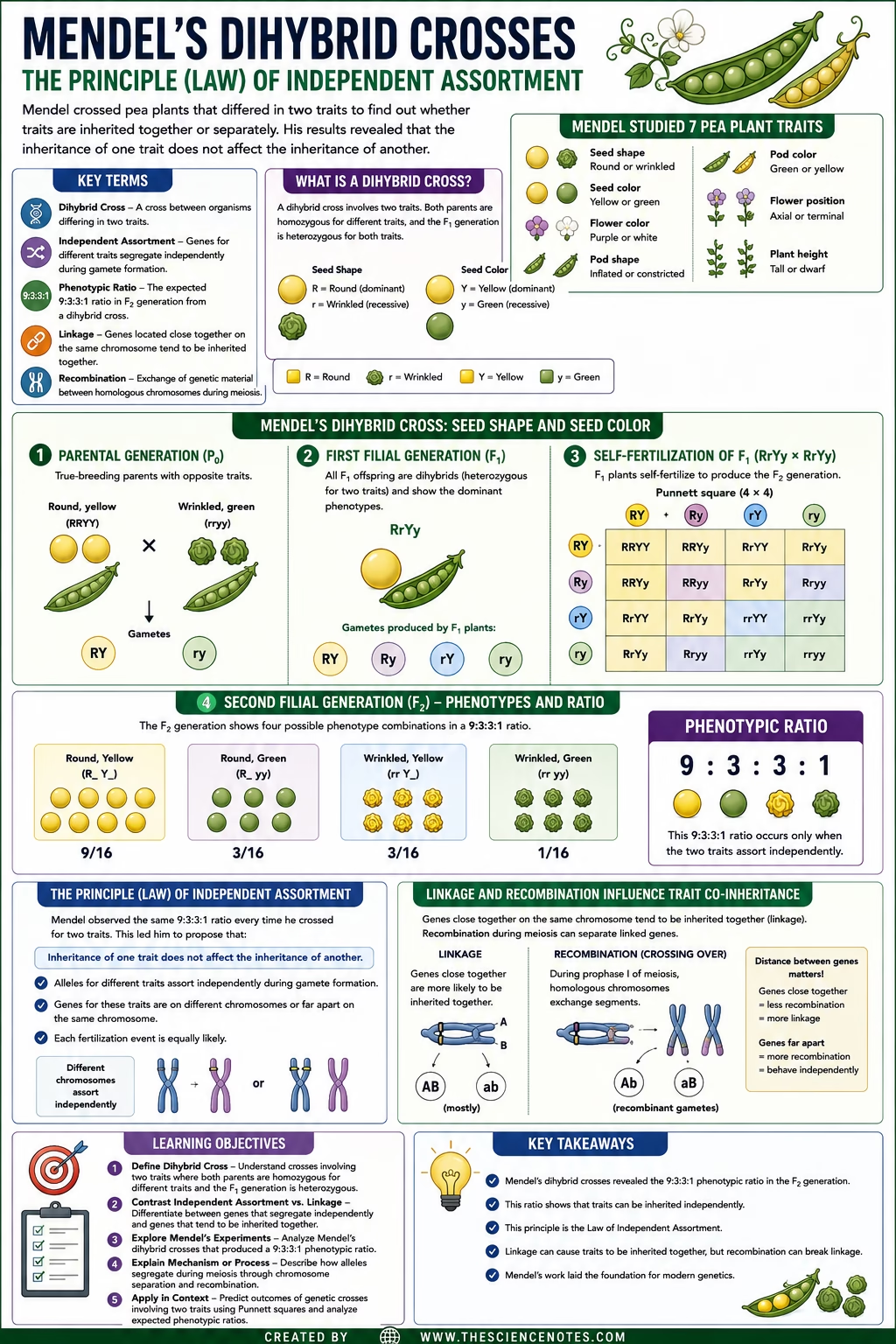
Mendel’s Parental Generation
In Mendel’s dihybrid cross, he began with two true-breeding pea plants. True-breeding organisms are homozygous for the traits being studied, meaning they carry two identical alleles for each gene.
For example, Mendel crossed:
RRYY × rryy
This means one parent was homozygous dominant for both traits and produced round, yellow seeds. The other parent was homozygous recessive for both traits and produced wrinkled, green seeds.
Each parent could produce only one type of gamete:
| Parent Genotype | Gamete Type |
|---|---|
| RRYY | RY |
| rryy | ry |
When these gametes combined, all offspring in the first filial generation received one dominant allele and one recessive allele for each trait.
The F1 Generation: All Dihybrids
The first generation of offspring is called the F1 generation. In Mendel’s example, all F1 plants had the genotype:
RrYy
These plants were dihybrids because they were heterozygous for two traits.
Their phenotype was:
Round, yellow seeds
This happened because round seed shape is dominant over wrinkled seed shape, and yellow seed color is dominant over green seed color. Even though the F1 plants carried recessive alleles for wrinkled shape and green color, those recessive traits were hidden by the dominant alleles.
This result matched Mendel’s earlier observations from monohybrid crosses: when true-breeding parents with contrasting traits are crossed, the F1 generation shows the dominant phenotype.
Self-Fertilization of the F1 Generation
Next, Mendel allowed the F1 plants to self-fertilize. This means the cross was:
RrYy × RrYy
Each F1 plant could produce four possible gamete combinations:
- RY
- Ry
- rY
- ry
These gametes form because each parent passes one allele for seed shape and one allele for seed color into each gamete. If the two genes assort independently, each gamete type should be equally likely.
When the F1 plants self-fertilized, the F2 generation showed four phenotype combinations:
- Round, yellow seeds
- Round, green seeds
- Wrinkled, yellow seeds
- Wrinkled, green seeds
The important result was the ratio of these phenotypes.
The 9:3:3:1 Phenotypic Ratio
Mendel observed that the F2 generation consistently produced a ratio close to:
9 : 3 : 3 : 1
This means that, out of 16 possible genetic combinations, the expected phenotypes are:
| F2 Phenotype | Expected Fraction |
|---|---|
| Round, yellow | 9/16 |
| Round, green | 3/16 |
| Wrinkled, yellow | 3/16 |
| Wrinkled, green | 1/16 |
This ratio is one of the classic signs of a dihybrid cross involving two independently assorting genes with complete dominance.
The largest group, 9/16, shows both dominant traits. The two middle groups, 3/16 and 3/16, each show one dominant trait and one recessive trait. The smallest group, 1/16, shows both recessive traits.
How a Dihybrid Punnett Square Works
A dihybrid Punnett square is usually a 4 × 4 grid because each heterozygous parent can produce four types of gametes.
For the cross RrYy × RrYy, the gametes are placed across the top and side of the square:
| RY | Ry | rY | ry | |
|---|---|---|---|---|
| RY | RRYY | RRYy | RrYY | RrYy |
| Ry | RRYy | RRyy | RrYy | Rryy |
| rY | RrYY | RrYy | rrYY | rrYy |
| ry | RrYy | Rryy | rrYy | rryy |
When the genotypes are converted into phenotypes, the result is the 9:3:3:1 ratio.
This Punnett square shows that inheritance involves probability. It does not mean every group of 16 offspring will exactly match the ratio. Instead, it means these are the expected outcomes when many offspring are produced.
The Law of Independent Assortment
Mendel’s dihybrid crosses led to the Law of Independent Assortment.
The Law of Independent Assortment states that alleles for different genes separate independently during gamete formation, as long as the genes are not linked.
In simple terms, inheriting one trait does not automatically determine the inheritance of another trait.
For example, in Mendel’s seed experiment, inheriting the allele for round seed shape did not force the plant to inherit yellow seed color. Seed shape and seed color behaved as separate inheritance events.
This is why the F2 generation included new trait combinations that were not present in the original parent plants, such as:
- Round, green seeds
- Wrinkled, yellow seeds
These new combinations showed that the two traits were not locked together.
Independent Assortment and Meiosis
Independent assortment occurs during meiosis, the cell division process that produces gametes such as sperm, eggs, pollen, and ovules.
During meiosis, chromosome pairs line up and separate. Genes located on different chromosomes usually assort independently because each chromosome pair separates without depending on how other chromosome pairs separate.
This random chromosome separation creates genetic variation. It allows offspring to inherit new combinations of traits that differ from those of their parents.
In a dihybrid cross, independent assortment explains why a heterozygous plant with genotype RrYy can produce four gamete types instead of only the two parental combinations.
Linkage: When Traits Are Inherited Together
Although Mendel’s pea plant experiments supported independent assortment, not all genes assort independently.
Genes located close together on the same chromosome may be inherited together. This is called genetic linkage.
When genes are linked, the inheritance of one trait can affect the likelihood of inheriting another trait. Linked genes do not usually produce the classic 9:3:3:1 ratio because their alleles tend to travel together into the same gametes.
For example, if two genes are very close to each other on the same chromosome, they are less likely to be separated during meiosis. As a result, offspring may show more parental trait combinations and fewer new combinations.
Recombination: How Linked Genes Can Separate
The inheritance of linked genes is influenced by recombination, also called crossing over.
During prophase I of meiosis, homologous chromosomes pair up and exchange matching DNA segments. This process can separate alleles that were originally located on the same chromosome.
The distance between two genes affects how often recombination separates them:
| Gene Position | Expected Inheritance Pattern |
|---|---|
| Genes close together | More likely to be inherited together |
| Genes far apart | More likely to be separated by recombination |
| Genes on different chromosomes | Usually assort independently |
This means that genes on the same chromosome can sometimes behave as if they assort independently, especially if they are far apart. Recombination helps explain why some of Mendel’s pea plant traits did not show obvious linkage.
Why Dihybrid Crosses Matter
Dihybrid crosses are important because they help students understand that inheritance is not limited to one trait at a time. Real organisms inherit many traits simultaneously, and each generation receives a new combination of alleles.
Dihybrid crosses help explain:
- How two traits can be studied at once
- Why the F2 generation can show four phenotype combinations
- How the 9:3:3:1 ratio supports independent assortment
- Why new trait combinations appear in offspring
- How meiosis creates genetic variation
- Why linkage can modify expected Mendelian ratios
For educators, dihybrid crosses are a useful bridge between basic Mendelian genetics and more advanced topics such as chromosome behavior, recombination frequency, genetic mapping, and non-Mendelian inheritance.
Key Terms in Dihybrid Crosses
| Term | Definition |
|---|---|
| Dihybrid cross | A genetic cross involving two traits |
| Independent assortment | The separation of alleles for different genes independently during gamete formation |
| Phenotypic ratio | The ratio of observable traits among offspring |
| 9:3:3:1 ratio | The expected F2 phenotype ratio in a classic dihybrid cross |
| Linkage | The tendency of genes close together on the same chromosome to be inherited together |
| Recombination | Exchange of genetic material between homologous chromosomes during meiosis |
| Dihybrid | An organism heterozygous for two genes |
| F1 generation | The first generation of offspring |
| F2 generation | The second generation of offspring |
Conclusion
A dihybrid cross is a genetic cross that examines the inheritance of two traits at the same time. Gregor Mendel used dihybrid crosses in pea plants to determine whether traits are inherited together or independently.
By crossing true-breeding plants with round, yellow seeds and wrinkled, green seeds, Mendel produced F1 plants that were all heterozygous and showed both dominant phenotypes. When these F1 dihybrids self-fertilized, the F2 generation showed four phenotype combinations in a predictable 9:3:3:1 ratio.
This ratio supported Mendel’s Law of Independent Assortment, which states that alleles for different genes separate independently during gamete formation. However, later genetic research showed that genes located close together on the same chromosome may be linked and inherited together. Recombination can separate linked genes, especially when they are far apart.
