A monohybrid cross is a genetic cross between two organisms that differ in only one trait. It is one of the most important concepts in introductory genetics because it helps explain how traits pass from parents to offspring. Gregor Mendel used monohybrid crosses in pea plants during the 1850s and 1860s to discover basic rules of inheritance.
Mendel’s work showed that traits do not simply blend together in offspring. Instead, organisms inherit separate genetic factors from each parent. Today, these factors are called genes, and different versions of a gene are called alleles.
Through his pea plant experiments, Mendel discovered two major principles: the Principle of Uniformity and the Law of Segregation. These principles became part of the foundation of modern genetics.
What Is a Monohybrid Cross?
A monohybrid cross examines the inheritance of one characteristic controlled by one gene. For example, a genetic cross studying only pea pod color is a monohybrid cross. If the cross studied both pod color and seed shape, it would no longer be monohybrid; it would be a dihybrid cross.
In a monohybrid cross, the two parents usually differ in one trait. For example, one pea plant may have green pods while another has yellow pods. Mendel crossed plants that were true-breeding, meaning they consistently produced offspring with the same trait when self-fertilized.
A true-breeding green pod plant produced only green pod offspring. A true-breeding yellow pod plant produced only yellow pod offspring. By crossing these plants, Mendel could observe which trait appeared in the next generation and which trait seemed to disappear.
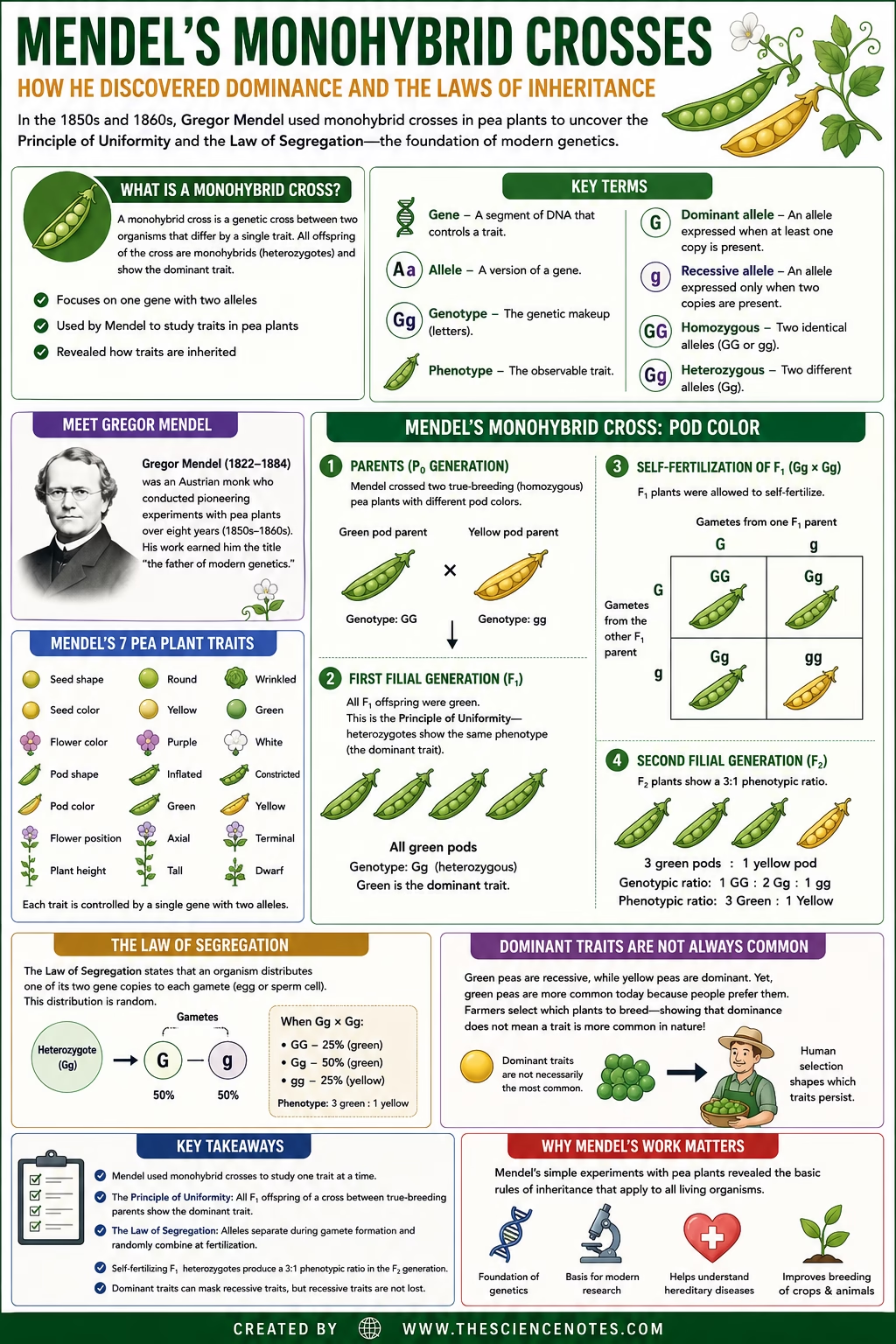
Why Mendel Used Pea Plants
Gregor Mendel, an Austrian monk, chose pea plants because they were practical for controlled breeding experiments. Pea plants grow quickly, produce many offspring, and have clear contrasting traits. Mendel could also control fertilization by transferring pollen between plants.
He studied seven pea plant characteristics, including:
| Characteristic | Contrasting Traits |
|---|---|
| Seed shape | Round or wrinkled |
| Seed color | Yellow or green |
| Flower color | Purple or white |
| Pod shape | Inflated or constricted |
| Pod color | Green or yellow |
| Flower position | Axial or terminal |
| Plant height | Tall or dwarf |
Each of these characteristics had two clearly visible forms. This made pea plants excellent organisms for studying inheritance patterns.
True-Breeding Parents and the P Generation
In Mendel’s monohybrid crosses, the original parent plants are called the parental generation, or P generation. These parent plants were true-breeding for different traits.
For example, Mendel crossed:
- A true-breeding green pod plant
- A true-breeding yellow pod plant
Using modern genetic notation, the green pod plant may be represented as GG, while the yellow pod plant may be represented as gg. The uppercase G represents the dominant green pod allele, while the lowercase g represents the recessive yellow pod allele.
Because both parents are homozygous, each parent can pass on only one type of allele. The green pod parent passes on G, and the yellow pod parent passes on g.
The cross is written as:
GG × gg
All offspring receive one G allele from the green pod parent and one g allele from the yellow pod parent. Therefore, all offspring have the genotype Gg.
The F1 Generation and the Principle of Uniformity
The offspring of the parental generation are called the first filial generation, or F1 generation. In Mendel’s pod color experiment, all F1 plants had green pods.
This was important because the yellow pod trait did not appear in the F1 generation. At the time, many scientists believed that offspring traits were a blend of parental traits. If blending inheritance were correct, Mendel might have expected an intermediate pod color. Instead, only green pods appeared.
This result supported the Principle of Uniformity.
The Principle of Uniformity states that when two true-breeding parents with different traits are crossed, all offspring in the F1 generation show the same phenotype.
In this case:
| Generation | Genotype | Phenotype |
|---|---|---|
| P parent 1 | GG | Green pods |
| P parent 2 | gg | Yellow pods |
| F1 offspring | Gg | Green pods |
The F1 plants were all heterozygous, meaning they had two different alleles: one dominant and one recessive. Even though they carried the yellow pod allele, they showed the green pod phenotype. Mendel concluded that green pod color was dominant over yellow pod color.
Dominant and Recessive Traits
A dominant trait appears when at least one dominant allele is present. A recessive trait appears only when an organism has two recessive alleles.
In the pea pod color example:
- G = dominant allele for green pods
- g = recessive allele for yellow pods
This gives three possible genotypes:
| Genotype | Phenotype |
|---|---|
| GG | Green pods |
| Gg | Green pods |
| gg | Yellow pods |
The heterozygous genotype Gg produces green pods because the dominant allele masks the recessive allele. However, the recessive allele is not destroyed or changed. It can still be passed to the next generation.
This was one of Mendel’s major insights: recessive traits can be hidden in one generation and reappear in a later generation.
Self-Fertilization and the F2 Generation
After producing the F1 generation, Mendel allowed the F1 plants to self-fertilize. Since all F1 plants were heterozygous Gg, the cross was:
Gg × Gg
Each F1 parent could produce two types of gametes:
- G gametes
- g gametes
Because allele separation is random, each heterozygous parent has a 50% chance of passing on G and a 50% chance of passing on g.
A Punnett square can show the possible outcomes:
| G | g | |
|---|---|---|
| G | GG | Gg |
| g | Gg | gg |
The possible genotypes are:
- 25% GG
- 50% Gg
- 25% gg
The genotype ratio is:
1 GG : 2 Gg : 1 gg
The phenotype ratio is:
3 green pods : 1 yellow pod
This 3:1 ratio appeared repeatedly in Mendel’s experiments. He observed the same pattern across different pea plant traits, which helped confirm that inheritance followed predictable rules.
The Law of Segregation
Mendel’s Law of Segregation explains why the 3:1 ratio appears in the F2 generation.
The Law of Segregation states that an organism has two alleles for a trait, but these alleles separate during gamete formation. Each gamete receives only one allele.
For example, a heterozygous plant with genotype Gg does not pass both alleles into one gamete. Instead, the alleles separate:
- Some gametes receive G
- Some gametes receive g
When fertilization occurs, one gamete from each parent combines to form the offspring’s genotype. This random combination produces the predictable 1:2:1 genotype ratio and 3:1 phenotype ratio in a simple monohybrid cross.
The Law of Segregation remains one of the central principles of Mendelian genetics.
Why Recessive Traits Can Reappear
One of the most important lessons from a monohybrid cross is that recessive traits can disappear in the F1 generation but reappear in the F2 generation.
In the pod color example, yellow pods disappear in the F1 generation because all plants are Gg and green is dominant. However, the yellow allele is still present. When two heterozygous F1 plants self-fertilize, two recessive alleles can combine to produce gg offspring.
This explains why a trait can seem to skip a generation. It was not lost; it was hidden by the dominant allele.
Dominant Traits Are Not Always Common
A common misunderstanding is that dominant traits are always more common than recessive traits. This is not true.
In genetics, dominant means that an allele is expressed when at least one copy is present. It does not mean the trait is better, stronger, or more common.
For example, in pea plants, yellow seed color is dominant over green seed color. However, green peas are commonly seen because people often prefer them as food. Farmers may select and breed plants that produce green peas, increasing the frequency of the green pea trait in crops.
This shows that trait frequency depends on many factors, including natural selection, artificial selection, survival, reproduction, environment, and human preference. Dominance alone does not determine how common a trait is in a population.
Importance of Monohybrid Crosses in Genetics Education
Monohybrid crosses are useful for students because they introduce several major genetics concepts in a simple format. They help explain:
- How alleles are inherited from parents
- How dominant and recessive traits work
- Why genotype and phenotype are not always the same
- How probability applies to inheritance
- Why recessive traits can skip generations
- How Punnett squares predict possible offspring outcomes
For educators, monohybrid crosses provide a strong starting point before teaching more complex inheritance patterns, such as dihybrid crosses, incomplete dominance, codominance, sex-linked inheritance, polygenic traits, and linked genes.
Key Terms in Monohybrid Crosses
| Term | Meaning |
|---|---|
| Gene | A DNA segment that helps control a trait |
| Allele | A version of a gene |
| Genotype | The allele combination an organism has |
| Phenotype | The observable trait |
| Homozygous | Having two identical alleles, such as GG or gg |
| Heterozygous | Having two different alleles, such as Gg |
| Dominant allele | An allele expressed when one or two copies are present |
| Recessive allele | An allele expressed only when two copies are present |
| P generation | The original parent generation |
| F1 generation | The first generation of offspring |
| F2 generation | The second generation of offspring |
Conclusion
A monohybrid cross is a genetic cross that studies the inheritance of one trait. Gregor Mendel used monohybrid crosses in pea plants to show that traits are inherited as separate units rather than blended together. His experiments revealed that dominant traits can mask recessive traits and that recessive traits can reappear in later generations.
Mendel’s results led to two foundational ideas in genetics: the Principle of Uniformity and the Law of Segregation. The Principle of Uniformity explains why all F1 offspring from two true-breeding parents show the same dominant phenotype. The Law of Segregation explains how alleles separate into gametes and recombine during fertilization.
