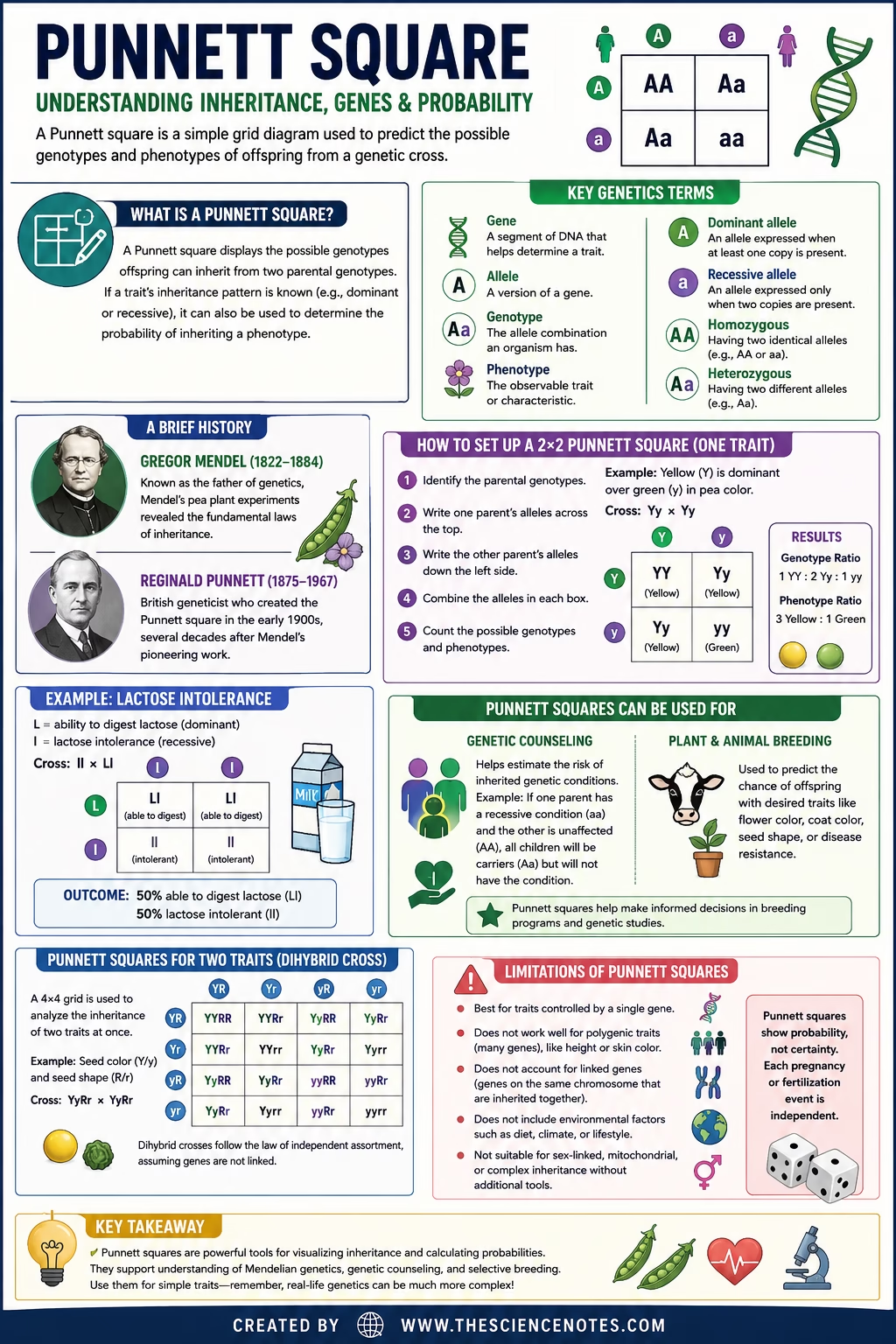
A Punnett square is one of the most useful visual tools in introductory genetics. It helps students predict the possible genotypes and phenotypes that offspring may inherit from two parents. In simple terms, a Punnett square is a grid that shows how alleles from each parent can combine during fertilization.
For students, Punnett squares make abstract genetic ideas easier to understand. For educators, they provide a clear way to teach inheritance, probability, dominant and recessive traits, and the connection between genes and observable characteristics. Although Punnett squares are simple, they remain powerful teaching tools more than 100 years after their creation.
However, Punnett squares are not perfect prediction machines. They work best for traits controlled by a single gene and inherited independently. More complex traits, such as height, skin color, intelligence, and many disease risks, usually involve multiple genes and environmental influences. In those cases, a Punnett square may be too simple to give an accurate prediction.
Table of Contents
ToggleWhat Is a Punnett Square?
A Punnett square is a diagram used to predict the possible genetic outcomes of a cross between two organisms. Each box in the square represents a possible combination of alleles that an offspring could inherit.
An allele is a version of a gene. For example, a gene may influence pea seed color, and different alleles may produce yellow or green seeds. A child, plant, or animal usually receives one allele from each parent for a given gene.
Punnett squares are commonly used to answer questions such as:
- What genotypes can offspring inherit?
- What phenotypes may appear in the next generation?
- What is the probability of inheriting a dominant or recessive trait?
- What percentage of offspring may be carriers of a genetic condition?
In classroom genetics, Punnett squares are often introduced through simple examples, such as flower color, pea color, seed shape, or inherited disorders.
Key Genetics Terms Students Should Know
Before using a Punnett square, students should understand several basic genetics terms.
| Term | Meaning |
|---|---|
| Gene | A segment of DNA that helps determine a trait |
| Allele | A version of a gene |
| Genotype | The allele combination an organism has |
| Phenotype | The observable trait or characteristic |
| Dominant allele | An allele expressed when at least one copy is present |
| Recessive allele | An allele expressed only when two copies are present |
| Homozygous | Having two identical alleles, such as YY or yy |
| Heterozygous | Having two different alleles, such as Yy |
| Gamete | A reproductive cell, such as sperm or egg |
A common mistake is thinking that a dominant allele is always “stronger” or more common. In genetics, dominant simply means that the allele’s effect is visible when one copy is present. Recessive means the trait appears only when two recessive alleles are inherited.
Historical Background: Mendel and Punnett
The Punnett square is named after Reginald Punnett, a British geneticist who introduced the diagram in the early 1900s. His work came after the discoveries of Gregor Mendel, an Austrian monk whose pea plant experiments formed the foundation of modern genetics.
Mendel studied traits such as pea color, pea shape, flower color, pod shape, pod color, flower position, and plant height. Through careful breeding experiments, he discovered patterns in how traits passed from one generation to the next.
For example, Mendel observed that purple flower color in pea plants could appear dominant over white flower color. He also showed that traits are inherited as discrete units, now called genes, rather than blending together in offspring.
Punnett squares are often used today to illustrate Mendel’s laws of inheritance, especially the law of segregation and the law of independent assortment.
How to Make a Simple Punnett Square
A basic Punnett square for one trait is usually a 2 × 2 grid. This type of cross is called a monohybrid cross because it examines one gene.
Here is the general process:
- Identify the parental genotypes.
- Separate the alleles each parent can pass on through gametes.
- Place one parent’s alleles across the top of the square.
- Place the other parent’s alleles along the left side.
- Fill in each box by combining the allele from the column and the allele from the row.
- Count the possible genotypes and phenotypes.
For example, suppose yellow pea color is dominant and green pea color is recessive. We can use:
- Y = dominant yellow allele
- y = recessive green allele
If both parents are heterozygous, their genotypes are Yy × Yy.
The Punnett square would produce these possible offspring genotypes:
| Y | y | |
|---|---|---|
| Y | YY | Yy |
| y | Yy | yy |
The results are:
- 25% YY — yellow peas
- 50% Yy — yellow peas
- 25% yy — green peas
The genotype ratio is 1 YY : 2 Yy : 1 yy.
The phenotype ratio is 3 yellow : 1 green.
This example shows how a recessive trait can disappear in one generation but reappear in the next when two recessive alleles come together.
Punnett Square Example: Lactose Intolerance
Punnett squares can also be used in simplified human genetics examples. For instance, in a classroom model of lactose digestion, imagine that the ability to digest lactose is represented by a dominant allele L, while lactose intolerance is represented by a recessive allele l.
If one parent is ll and the other parent is Ll, the cross would be:
| l | l | |
|---|---|---|
| L | Ll | Ll |
| l | ll | ll |
The possible outcomes are:
- 50% Ll — able to digest lactose
- 50% ll — lactose intolerant
This means each child has a 1 in 2 chance of inheriting each outcome in this simplified model. It is important to remind students that real human traits can be more complicated than classroom examples suggest.
Punnett Squares and Probability
A Punnett square shows probability, not certainty. If a cross gives a 25% chance of a recessive trait, that does not mean exactly one out of every four children in a family will have the trait. Instead, each fertilization event has the same probability.
A useful classroom comparison is flipping a coin. A coin has a 50% chance of landing heads, but flipping it four times does not guarantee two heads and two tails. In the same way, genetic probabilities describe possible outcomes over many events, not guaranteed results for a small number of offspring.
This distinction is especially important when discussing human inheritance. A 25% risk for a genetic condition applies to each pregnancy independently.
Punnett Squares for Two Traits
Punnett squares can also show the inheritance of two traits at once. This is called a dihybrid cross and usually uses a 4 × 4 grid.
For example, a teacher may use a dihybrid cross to examine pea color and pea shape together. However, dihybrid crosses become more complex because each parent can produce several allele combinations.
Punnett squares can technically be expanded for more traits, but they quickly become large and difficult to use. For more than two traits, educators often introduce probability rules, branching diagrams, or digital genetics tools instead.
Real-World Uses of Punnett Squares
Punnett squares are not limited to biology classrooms. They are also useful in applied genetics.
Genetic Counseling
Genetic counselors may use Punnett squares to explain inheritance risks for certain single-gene disorders. For example, cystic fibrosis is commonly discussed as a recessive genetic condition. In a simplified case, if one parent has two recessive disease-causing alleles and the other parent has two non-disease alleles, their children would be carriers but would not be expected to have the condition.
However, real genetic counseling involves more than a Punnett square. Counselors may also use family history, genetic testing, population data, and medical information.
Plant and Animal Breeding
Punnett squares are also useful in agriculture. Plant and animal breeders may use them to estimate the chance of producing offspring with desirable traits, such as flower color, seed type, coat color, or disease resistance.
For example, a breeder may want to increase the likelihood of a specific flower color in the next generation. A Punnett square can help identify which parent organisms are most likely to produce that result.
Limitations of Punnett Squares
Although Punnett squares are valuable, they have important limitations.
First, they work best for traits controlled by a single gene locus. Many traits are polygenic, meaning they are influenced by multiple genes. Human height is a good example. Height is affected by many genes as well as environmental factors such as nutrition and health.
Second, Punnett squares assume that traits are independently inherited. This is not always true. Genes located close together on the same chromosome may be inherited together, a pattern called genetic linkage. Linked genes do not follow the simple independent assortment pattern shown in basic Punnett squares.
Third, some traits involve incomplete dominance, codominance, sex-linked inheritance, epigenetic effects, mitochondrial inheritance, or environmental influence. These patterns require more advanced models.
Therefore, a Punnett square should be seen as a learning and prediction tool, not a complete explanation of all inheritance.
Teaching Tips for Educators
Punnett squares are most effective when students move from simple to complex examples. Begin with one trait, such as pea color or flower color. Then introduce vocabulary such as genotype, phenotype, homozygous, heterozygous, dominant, and recessive.
Educators can also ask students to explain the meaning of each box in the square. Each box represents a possible fertilization event, not a guaranteed child or offspring. This helps prevent misunderstanding about genetic probability.
Visual learners may benefit from color coding dominant and recessive alleles. Kinesthetic learners may enjoy using cards, beads, or paper slips to represent gametes and allele combinations.
Conclusion
A Punnett square is a simple but powerful tool for understanding genetic inheritance. It helps students and educators visualize how alleles from two parents may combine in offspring. By organizing genetic information into a grid, Punnett squares make it easier to predict possible genotypes, phenotypes, and inheritance probabilities.
Punnett squares are especially useful for single-gene traits that follow dominant and recessive inheritance patterns. They can also support lessons on Mendelian genetics, probability, genetic counseling, and selective breeding.
At the same time, students should understand the limits of this tool. Many real-world traits are influenced by multiple genes, linked genes, environmental conditions, or more complex inheritance patterns. When used correctly, the Punnett square remains one of the clearest introductions to genetics and heredity.
