PhD is not nothing. This is my honest letter about the years of sacrifice, failure, endurance, and resilience behind earning a PhD in cell and molecular biology. I am not complaining, and I am not asking for pity. I am simply telling the truth of a journey that many people dismiss without understanding what it costs.
To my friends who have a master’s degree and say a PhD is nothing,
to my friends who have a PhD and still say a PhD is nothing,
and to my friends who did not go through higher education but still say a PhD is nothing—
I am writing this with respect, not anger.
I am not writing to compare my life with yours. I am not writing to say that my struggle is greater than anyone else’s. I am not writing to suggest that education makes one person more valuable than another. I know very well that intelligence, discipline, wisdom, and success exist far beyond universities, laboratories, degrees, titles, and institutions.
I respect every path.
I respect the person who earned a master’s degree and worked hard for it.
I respect the person who earned a PhD and survived a journey only they truly understand.
I respect the person who never went to school but built a life through experience, sacrifice, labor, instinct, and resilience.
This letter is not about superiority.
This letter is about truth.
Because when someone says, “A PhD is nothing,” something inside me refuses to stay silent.
Not because I am offended by a sentence.
Not because I need applause.
Not because I want pity.
Not because I regret my path.
But because I know what it cost.
And I know that calling a PhD “nothing” erases years of invisible labor, silent suffering, intellectual pressure, emotional endurance, and sacrifices that most people never see.
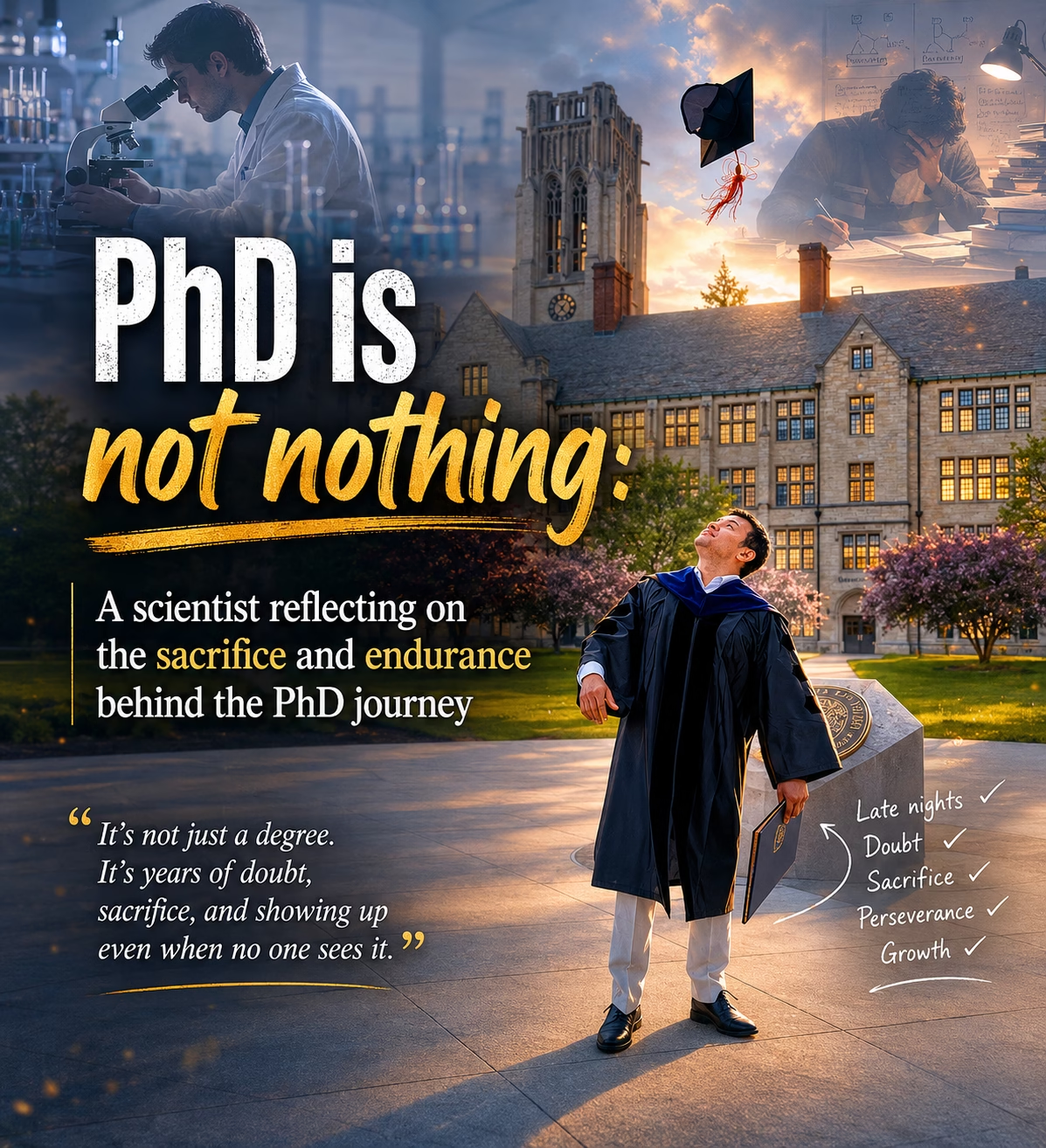
A PhD is not just a degree.
It is not just three letters after a name.
It is not just a graduation gown.
It is not just a thesis printed, signed, and placed on a shelf.
It is not just a defense presentation, a few publications, or a line added to a CV.
A PhD is a life chapter that consumes you.
It changes how you think.
It changes how you work.
It changes how you fail.
It changes how you survive.
For six to seven years, sometimes longer, you live inside uncertainty. You wake up every day with a question that may not give you an answer. You design experiments that may fail. You spend months building something that can collapse in one afternoon. You invest your mind, body, emotions, and time into a project that does not promise success simply because you worked hard.
That is one of the hardest truths about science:
Effort does not guarantee results.
In many parts of life, if you work harder, you can often see progress. But in research, especially in cell and molecular biology, hard work does not always mean clean data. Discipline does not always mean the cells will survive. Intelligence does not always mean the experiment will work. Passion does not prevent contamination. Hope does not fix a failed transfection. Prayer does not always bring back a dead culture.
You can do everything carefully and still get nothing.
You can follow the protocol exactly and still fail.
You can repeat the experiment ten times and still not understand what is wrong.
You can spend weeks troubleshooting a method only to discover the issue was a reagent, a cell line, a passage number, an antibody, a primer, a timing problem, or biology itself refusing to behave the way you expected.
And still, you return.
You return to the biosafety cabinet.
You return to the incubator.
You return to the microscope.
You return to the centrifuge, the pipettes, the culture media, the plates, the tubes, the reagents, the notebook, the data, the question.
You return not because it is easy.
You return because quitting would make all the suffering meaningless, and because somewhere inside you, even after exhaustion, there is still a scientist who wants to know the answer.
That is what people do not see.
They see the title, but not the trembling hands after another failed experiment.
They see the degree, but not the weekends spent feeding cells.
They see the word “doctor,” but not the nights spent doubting whether you are good enough.
They see the final presentation, but not the years of broken timelines behind it.
They see the publication, but not the rejected manuscripts, revised figures, repeated experiments, and painful comments that came before it.
People see the finished sentence.
They do not see the years it took to write it.
A PhD in cell and molecular biology is not a simple academic exercise. It is not just reading, memorizing, and passing exams. It is living inside biological complexity. It is trying to understand life at a level where life does not always cooperate.
Cells do not care about your deadline.
Cells do not care about your committee meeting.
Cells do not care that you are tired.
Cells do not care that your graduation depends on them.
Cells do not care that your family is asking when you will finish.
Cells do not care that your friends are moving forward in life while you are still repeating the same experiment.
Cells grow when they grow.
Cells die when they die.
And sometimes, they teach you humility in the cruelest way.
In this journey, you learn that science is not as glamorous as people imagine. It is not always discovery, celebration, and breakthrough. Much of it is repetition. Much of it is failure. Much of it is waiting. Much of it is silence.
Waiting for cells to reach the right confluency.
Waiting for results.
Waiting for sequencing.
Waiting for reviewers.
Waiting for feedback.
Waiting for your supervisor.
Waiting for a signal that maybe, finally, this project is moving.
And while you wait, life continues around you.
People get married.
People buy houses.
People have children.
People build careers.
People earn stable salaries.
People ask you, “Are you still in school?”
People ask, “When will you be done?”
People ask, “What exactly are you doing?”
People say, “So you are just studying?”
And you smile, because explaining the truth would take too long.
How do you explain that you are not “just studying”?
How do you explain that you are trying to create knowledge that did not exist before?
How do you explain that your work is not just learning from a textbook, but standing at the edge of what is known and trying to push it forward by one small, fragile step?
That is what a PhD is.
It is not only consuming knowledge.
It is producing knowledge.
And producing knowledge is painful because there is no answer key. There is no teacher’s manual. There is no guaranteed path. There is only a question, a hypothesis, a method, a failure, a revision, another failure, a small clue, a new direction, another obstacle, and the decision to keep going.
That decision—to keep going—is the soul of the PhD.
Not the title.
Not the certificate.
Not the robe.
Not the applause.
The soul of the PhD is the decision to continue when the evidence around you gives you every reason to stop.
So when people say, “A PhD is nothing,” I wonder what they think “something” is.
Is endurance nothing?
Is sacrifice nothing?
Is intellectual discipline nothing?
Is emotional survival nothing?
Is failing repeatedly and still returning nothing?
Is giving six or seven years of your life to a scientific question nothing?
Is losing sleep, comfort, certainty, money, time, and peace nothing?
Is carrying a project through disappointment after disappointment nothing?
If that is nothing, then what do we call strength?
To my friends with a master’s degree: I respect your journey. A master’s degree is not easy. It requires effort, discipline, and sacrifice. But a PhD is a different kind of journey. It is not only about completing coursework or demonstrating knowledge. It is about independence. It is about creating something original. It is about surviving years of uncertainty while being expected to become an expert in a field that keeps humbling you.
A master’s degree can be a mountain.
A PhD is a wilderness.
In a mountain, the summit is visible. In a wilderness, sometimes you do not even know if the path exists. You walk, you get lost, you redraw the map, and you keep moving.
To my friends who have a PhD and say a PhD is nothing: I understand, but I also challenge you.
Maybe you say it because you are humble.
Maybe you say it because you do not want to sound proud.
Maybe you say it because time has softened the memory.
Maybe you say it because you survived, and survival sometimes makes people minimize the wound.
Maybe you say it because you are now in a new stage where the PhD feels like the beginning, not the peak.
But you know the truth.
You know what it took.
You know the pressure.
You know the failures.
You know the revisions.
You know the fear.
You know the loneliness.
You know the moment when you questioned whether you belonged.
You know the weight of being called “almost done” for years while not feeling done at all.
You know it was not nothing.
And sometimes, when those of us who survived minimize the journey, we unintentionally make it easier for others to disrespect it. We make the suffering look imaginary. We make the endurance look ordinary. We make the sacrifices look small.
Humility is good.
But erasing the truth is not humility.
To my friends who did not go through higher education: I respect you too. A degree does not define human worth. A person can be brilliant without a diploma. A person can be successful without a university. A person can be wise without formal education. Life itself is a severe teacher, and many people have passed exams that no institution ever recorded.
But not walking a path does not make the path easy.
You do not have to experience something personally to respect its difficulty. I may not know the full weight of your life, your work, your struggles, your sacrifices—but I can still honor them. In the same way, I ask you to understand that a PhD is not simply “more school.” It is a long, uncertain, demanding apprenticeship in thinking, failing, discovering, writing, defending, and becoming.
I am not saying everyone has the same PhD story. Every person’s journey has its own details. Different labs. Different mentors. Different projects. Different cultures. Different pressures. Different wounds.
But I believe many of us carry a similar truth.
Many of us know what it feels like to be exhausted and still productive.
Many of us know what it feels like to smile while quietly falling apart.
Many of us know what it feels like to defend our work while still doubting ourselves.
Many of us know what it feels like to be surrounded by people but still feel alone in our project.
Many of us know what it feels like to sacrifice years of life for a result that may fit into one figure.
One figure.
That is the strange cruelty of science. A year of work can become one panel in one paper. A thousand hours can become a single bar graph. Months of troubleshooting can become one sentence in the methods section. Pain becomes data. Failure becomes experience. Survival becomes a CV line.
But behind that one figure is a human being.
A human being who showed up again and again.
I am that human being.
I am telling my story, but I know I am not alone.
I am not complaining. Let me say that clearly.
I am not complaining.
I chose this path. I stayed on this path. I have not given up on this path. Even after the PhD, I extended the journey into a postdoc. And in many ways, the postdoc feels like the same road continuing—same uncertainty, same experiments, same pressure, same hope, same failures, same need to prove yourself again and again.
The only difference is that now the letters “PhD” come after my name.
But those letters did not make science easier.
They did not make cells behave.
They did not make experiments obey.
They did not remove pressure.
They did not remove rejection.
They did not remove the need to keep fighting for data, funding, publications, recognition, and a future.
The PhD ended, but the journey did not.
The defense ended, but the discipline continued.
The degree was awarded, but the struggle evolved.
The title changed, but the work remained demanding.
That is why I cannot accept the phrase “PhD is nothing.”
Because for me, the PhD was not an empty title.
It was the season where I learned endurance.
It was the season where I learned that failure is not always the opposite of progress.
It was the season where I learned that intelligence is not enough without persistence.
It was the season where I learned patience from cells, discipline from protocols, humility from failed experiments, and courage from starting over.
It was the season where I learned that becoming a scientist is not only about knowing answers, but about surviving questions.
And the questions are heavy.
Am I good enough?
Is my project good enough?
Will this experiment ever work?
Will I publish?
Will I graduate?
Will I find a position after this?
Will all these years mean something?
Will anyone understand what this cost me?
These questions follow you.
Sometimes they follow you home.
Sometimes they follow you to bed.
Sometimes they sit with you in silence while everyone else thinks you are simply “busy.”
That is the part many people do not see: the mental weight.
A PhD tests more than your intelligence. It tests your identity. It tests your patience. It tests your emotional stability. It tests your ability to separate your worth from your results.
That is difficult, because in research, your results often feel personal.
When an experiment fails, it can feel like you failed.
When your data is unclear, it can feel like your mind is unclear.
When your paper is rejected, it can feel like your work has no value.
When your project stalls, it can feel like your life is stalled.
A PhD teaches you, painfully, that you are not your failed experiment.
But learning that lesson takes years.
And even when you learn it, you sometimes have to learn it again.
So no, I am not asking anyone to worship a PhD. I am not asking anyone to bow to a title. I do not believe a degree makes someone better, kinder, wiser, or more important than another person. I have met people with degrees who lack humility, and people without degrees who carry deep intelligence and grace.
A PhD is not everything.
But it is not nothing.
It is not everything, because no degree can measure the whole value of a human being.
It is not nothing, because no honest person should dismiss years of disciplined suffering as if they were meaningless.
Both things can be true.
A PhD does not make me superior.
But it did shape me.
It did test me.
It did cost me.
It did demand something from me that casual observers may never understand.
And I am allowed to name that cost.
I am allowed to say it was hard.
I am allowed to say it hurt.
I am allowed to say it changed me.
I am allowed to say I survived something difficult without being accused of complaining.
There is a difference between complaining and witnessing.
Complaining says, “Feel sorry for me.”
Witnessing says, “See the truth.”
I am not asking for pity.
I am asking for recognition of truth.
The truth is that many PhD students suffer quietly.
The truth is that many scientists carry invisible pressure.
The truth is that academic training can be brutal, isolating, and deeply demanding.
The truth is that discovery often comes after long seasons of failure.
The truth is that people often celebrate the final degree without understanding the years of endurance behind it.
So when I speak about the difficulty, I am not weakening the PhD.
I am honoring it.
I am honoring every failed experiment that taught me something.
I am honoring every late night that demanded discipline.
I am honoring every weekend in the lab that no one noticed.
I am honoring every tear hidden behind professionalism.
I am honoring every moment I wanted to stop but did not.
I am honoring the version of myself who kept going when no one was clapping.
That version of me deserves respect.
So does every PhD student who is still in the middle of the storm.
The student whose project is not working.
The student whose supervisor does not understand how tired they are.
The student whose family thinks they are taking too long.
The student whose friends have stopped asking about their work because the answer is always complicated.
The student who looks successful on the outside but is fighting silently on the inside.
The student who is still waiting for one good result to prove that the years have not been wasted.
To that student, I want to say:
Your journey is not nothing.
Even if people do not understand it.
Even if your experiments fail.
Even if your timeline changes.
Even if your confidence shakes.
Even if you are tired of explaining yourself.
Your endurance matters.
And to everyone who speaks lightly about a PhD, I ask only this:
Do not dismiss what you have not carried.
Do not minimize what someone else had to survive.
Do not reduce years of sacrifice to a joke.
Do not confuse humility with erasure.
Do not call something “nothing” simply because you do not see the cost.
A PhD is not just about becoming a doctor.
It is about becoming someone who can stand in uncertainty and still think.
Someone who can fail and still return.
Someone who can be criticized and still improve.
Someone who can be exhausted and still disciplined.
Someone who can lose confidence and still continue.
Someone who can spend years with a question and refuse to abandon it too early.
That kind of transformation is not nothing.
It is one of the most difficult forms of becoming.
At the end of the journey, people may see only the title.
But I see the whole road.
I see the first day, when everything felt possible.
I see the middle years, when everything felt impossible.
I see the failed experiments, the repeated protocols, the contaminated cultures, the confusing data, the meetings, the deadlines, the revisions, the silence, the pressure, the fear, the endurance.
I see the version of myself who kept showing up.
I see the version of myself who did not give up.
I see the version of myself who became stronger, not because the journey was easy, but because it was not.
That is why I will never call it nothing.
A PhD is not nothing.
It is a long argument with uncertainty.
It is a daily negotiation with failure.
It is a discipline of returning.
It is a test of patience, identity, courage, and endurance.
It is years of invisible work behind a visible title.
It is sacrifice that often looks ordinary from the outside but feels monumental from within.
And for those of us in science, especially in cell and molecular biology, it is also a relationship with life at its smallest and most unpredictable levels. It is learning that living systems are complex, stubborn, fragile, beautiful, and humbling.
It is learning that discovery is not handed to you.
You earn it slowly.
You earn it through failed plates.
You earn it through unclear bands.
You earn it through dead cells.
You earn it through repeated assays.
You earn it through rejected drafts.
You earn it through long days, late nights, and quiet mornings when you return to the lab again.
And when you finally earn the degree, people may say, “Congratulations.”
But even that word cannot hold the whole story.
Because the real story is not just that you finished.
The real story is that you continued.
You continued when it was hard.
You continued when it was lonely.
You continued when nothing worked.
You continued when people misunderstood.
You continued when the future was uncertain.
You continued when the only evidence of your strength was the fact that you showed up again.
That is the truth of my story.
And maybe it is the truth of many others too.
So to anyone who says a PhD is nothing, I will answer with calmness, not bitterness:
A PhD may not be everything.
But it is not nothing.
It is not nothing to the person who lived it.
It is not nothing to the person who suffered through it.
It is not nothing to the person who sacrificed years for it.
It is not nothing to the person who had to become stronger in order to survive it.
The letters “PhD” may be small.
But the journey behind them is not.
And I will never apologize for telling the truth about what it took to earn them.
And yes, ChatGPT helped me write this letter—too bad it wasn’t there when I actually needed help surviving the PhD.
